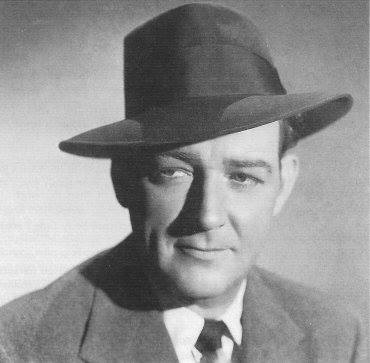
Happy Birthday, William Gargan
William Gargan, who brought a wry cynicism to his characters on radio, was born today in 1905. Of all the actors to play private eyes and gumshoes during the Golden Age of Radio, Gargan may have been the most uniquely qualified. Ironically, while success as a detective seemed to elude him, he enjoyed a great deal of success by playing detectives on film, television, and radio.
His father was a bookie, and as a boy Gargan would accompany him when he made his collection and payment rounds. During Prohibition, he dropped out of school and became a salesman of bootleg liquor to speakeasies in New York; his sales partner during this time was Dave Chasen, who would later go on to open Hollywood's Brown Derby restaurant. The two would remain lifelong friends. For a time, Gargan worked as a collection agent for a department store. On one of his jobs, he was shot at by an irate customer. He lost another job as an operative for a detective agency when the subject he was assigned to follow eluded the tail.
Gargan found more success as an actor than he did as a detective. He turned to acting in the 1920s and appeared in dozens of films, including two turns as Ellery Queen in 1942. In 1946, Gargan had his first run at radio crimesolving, starring as private eye Ross Dolan in ABC's I Deal in Crime (launched alongside another ABC detective series, The Fat Man with J. Scott Smart). That series only ran for eleven months, but Gargan found more success a few years later on NBC radio and TV as Martin Kane, Private Eye. Gargan starred in the radio and TV series for two years before frustration over the quality of the scripts drove him out. As Gargan later recalled in his 1969 autobiography, "Very soon in the game, I realized our stories were nothing to rave about. How much well plotted story line and genuine character development can you accomplish in a half-hour? So I made the program a showcase for me. After all, that was what we were selling - Martin Kane. I developed a tongue-in-cheek style, a spoof of the hard-boiled detective, a way of silently saying, 'Don't blame me for the lousy stories, I didn't write them. And anyway, what's the difference? Relax.'"
Given his attitude towards the caliber of radio detective scripts, it may come as a surprise that Gargan came back for another run as a radio shamus. Maybe it was because he was past his leading man prime in 1951 when the offer was made to star in a new series on NBC. It might have been the money that was on the table; NBC brought him to their network with a $1 million contract for five years. The deal covered the new series and other radio and TV appearances.
The series was launched as part of NBC's silver anniversary celebration under the title The Adventures of Barrie Crane. Gargan used the spelling of his own son's name for the title character, and while the character's surname switched to "Craig," the characterization was intact from the beginning. Craig was a wry, sly operator in the mold of Philip Marlowe and Sam Spade. He narrated his adventures with a tongue in cheek style that kept the hard boiled business in check. He was loyal to his clients and friendly with the police (in the person of Ralph Bell's Lt. Rogers). From 1951 until July 1954, Barrie Craig was broadcast from NBC in New York. For the last run of the series, production shifted to Hollywood. It left the air in September 1954 but returned for a 39 week run beginning in October before Barry Craig closed his last case.
Sadly, William Gargan's acting career came to an end only a few years after Barry Craig left the air. He returned as Martin Kane for 39 syndicated episodes in 1957, but throat cancer diagnosed in 1958 ended his work on the screen. Doctors removed his larynx in 1960 and he was outfitted with a voice box. He spent the remaining years of his life as a crusader and activist for the American Cancer Society, cautioning against the dangers of smoking. The Screen Actors Guild honored his career and his philanthropic work when it awarded Gargan with their lifetime achievement award in 1967. He passed away at age 73 in 1979. Cancer may have taken William Gargan's voice, but his talent and his performances will live forever in these wonderful mystery shows from the Golden Age of Radio.
Available Results
Generated results are saved to your library for reuse and search.
Choose Template
Pick the result you want. You can review provider and model before generating.
A concise first-pass summary for understanding the episode quickly.
A comprehensive, source-grounded extraction of the reusable knowledge in an episode.
A comprehensive extraction focused on opportunities, strategy, markets, and company building.
Explicit actions, next steps, habits, recommendations, and things to avoid.
Repeatable methods, frameworks, mental models, processes, and systems.
A dedicated inventory of concrete resources named in the episode.
A concise first-pass summary for understanding the episode quickly.
A detailed readable summary organized by chapter or topic.
A navigable map of subjects, topic flow, and suggested chapters.
A comprehensive, source-grounded extraction of the reusable knowledge in an episode.
Reusable atomic knowledge units extracted from the episode.
A comprehensive extraction focused on health practices, protocols, claims, and safety caveats.
A comprehensive extraction focused on opportunities, strategy, markets, and company building.
Explicit actions, next steps, habits, recommendations, and things to avoid.
A dedicated inventory of concrete resources named in the episode.
A dedicated analysis of warnings, limitations, trade-offs, weak evidence, and uncertainty.
A concise first-pass summary for understanding the episode quickly.
A detailed readable summary organized by chapter or topic.
A navigable map of subjects, topic flow, and suggested chapters.
A comprehensive, source-grounded extraction of the reusable knowledge in an episode.
Reusable atomic knowledge units extracted from the episode.
A comprehensive extraction focused on health practices, protocols, claims, and safety caveats.
A comprehensive extraction focused on opportunities, strategy, markets, and company building.
Scientific findings, mechanisms, studies, hypotheses, and the limits of the evidence discussed.
Technologies, AI models, technical methods, capabilities, limitations, and adoption implications.
Investment theses, assets, catalysts, valuation reasoning, time horizons, and risks.
Chronologies, actors, causes, consequences, turning points, and competing historical interpretations.
Policies, proposals, stakeholders, arguments, implementation constraints, and predicted effects.
Career paths, skills, hiring signals, workplace decisions, transitions, and limitations of the advice.
Behavioral mechanisms, biases, motivation, habits, emotions, interventions, and evidence limitations.
Economic mechanisms, incentives, indicators, market structure, forecasts, and uncertainty.
Leadership principles, team systems, organizational design, culture, feedback, and failure modes.
Audience, positioning, messaging, acquisition, retention, experiments, metrics, and failed approaches.
Teaching methods, learning strategies, practice, feedback, assessment, and effectiveness evidence.
Theses, premises, arguments, objections, values, thought experiments, and unresolved questions.
Communication patterns, conflict, boundaries, expectations, repair methods, and contextual limitations.
Books, papers, authors, courses, and other learning resources mentioned in the episode.
Repeatable methods, frameworks, mental models, processes, and systems.
Explicit actions, next steps, habits, recommendations, and things to avoid.
Memorable statements and important claims with attribution and source context.
A dedicated inventory of concrete resources named in the episode.
A dedicated analysis of warnings, limitations, trade-offs, weak evidence, and uncertainty.