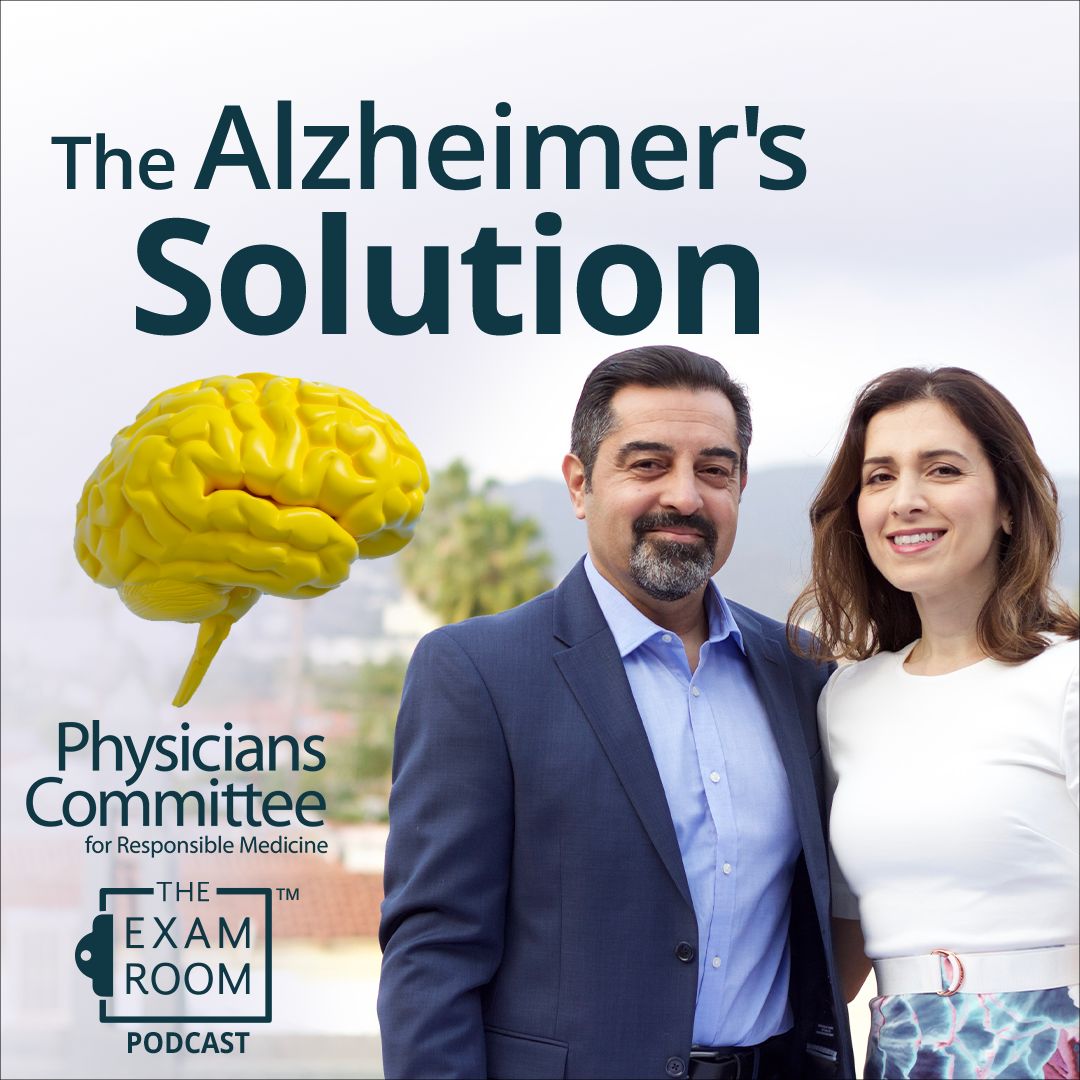
Best and Worst Foods for Alzheimer's Disease | Drs. Dean and Ayesha Sherzai
Eating fast food can be traumatic for the brain. In turn, the toxicity can increase the chance that you may develop Alzheimer's disease.
On this episode of The Exam Room™, Drs. Dean and Ayesha Sherzai join "The Weight Loss Champion" Chuck Carroll to explain why foods loaded with fat, sugar and salt can send brain cells into a frenzy! These are the very foods that are staples of the standard American diet!
You will also learn the enormous number of calories the brain burns every day and how much better it can function by eating a healthy diet that contains plenty of whole fruits, vegetables, grains, and legumes. Eating these foods every day can also dramatically reduce the odds that you will become one of the millions of Americans who have been diagnosed with Alzheimer's disease.
Plus, Team Sherzai, authors of The 30-Day Alzheimer's Solution, reveals the brain power boosting foods you need to bring home to your kitchen!
— — —
30 Day Alzheimer's Solution Book
— — —
Team Sherzai
IG: @sherzaimd
Twitter: @SherzaiMD
— — —
PCRM Alzheimer's Resources
https://www.pcrm.org/alzheimers
— — —
International Conference on Nutrition in Medicine 2021
Register: https://pcrm.org/icnm
— — —
Chuck Carroll
IG: @ChuckCarrollWLC
Twitter: @ChuckCarrollWLC
Facebook: https://wghtloss.cc/ChuckFacebook
— — —
Barnard Medical Center Telemedicine
Schedule Appointment
202-527-7500
— — —
Physicians Committee
Twitter: @PCRM
Facebook: https://wghtloss.cc/PCRMFacebook
YouTube: https://bit.ly/PCRMYouTube
— — —
Share the Show
Please subscribe and give the show a 5-star rating on Apple Podcasts, Spotify or many other podcast providers. Don't forget to share it with a friend for inspiration!
Available Results
Generated results are saved to your library for reuse and search.
Choose Template
Pick the result you want. You can review provider and model before generating.
A concise first-pass summary for understanding the episode quickly.
A comprehensive, source-grounded extraction of the reusable knowledge in an episode.
A comprehensive extraction focused on health practices, protocols, claims, and safety caveats.
A dedicated analysis of warnings, limitations, trade-offs, weak evidence, and uncertainty.
Repeatable methods, frameworks, mental models, processes, and systems.
Technologies, AI models, technical methods, capabilities, limitations, and adoption implications.
A concise first-pass summary for understanding the episode quickly.
A detailed readable summary organized by chapter or topic.
A navigable map of subjects, topic flow, and suggested chapters.
A comprehensive, source-grounded extraction of the reusable knowledge in an episode.
Reusable atomic knowledge units extracted from the episode.
A comprehensive extraction focused on health practices, protocols, claims, and safety caveats.
A comprehensive extraction focused on opportunities, strategy, markets, and company building.
Explicit actions, next steps, habits, recommendations, and things to avoid.
A dedicated inventory of concrete resources named in the episode.
A dedicated analysis of warnings, limitations, trade-offs, weak evidence, and uncertainty.
A concise first-pass summary for understanding the episode quickly.
A detailed readable summary organized by chapter or topic.
A navigable map of subjects, topic flow, and suggested chapters.
A comprehensive, source-grounded extraction of the reusable knowledge in an episode.
Reusable atomic knowledge units extracted from the episode.
A comprehensive extraction focused on health practices, protocols, claims, and safety caveats.
A comprehensive extraction focused on opportunities, strategy, markets, and company building.
Scientific findings, mechanisms, studies, hypotheses, and the limits of the evidence discussed.
Technologies, AI models, technical methods, capabilities, limitations, and adoption implications.
Investment theses, assets, catalysts, valuation reasoning, time horizons, and risks.
Chronologies, actors, causes, consequences, turning points, and competing historical interpretations.
Policies, proposals, stakeholders, arguments, implementation constraints, and predicted effects.
Career paths, skills, hiring signals, workplace decisions, transitions, and limitations of the advice.
Behavioral mechanisms, biases, motivation, habits, emotions, interventions, and evidence limitations.
Economic mechanisms, incentives, indicators, market structure, forecasts, and uncertainty.
Leadership principles, team systems, organizational design, culture, feedback, and failure modes.
Audience, positioning, messaging, acquisition, retention, experiments, metrics, and failed approaches.
Teaching methods, learning strategies, practice, feedback, assessment, and effectiveness evidence.
Theses, premises, arguments, objections, values, thought experiments, and unresolved questions.
Communication patterns, conflict, boundaries, expectations, repair methods, and contextual limitations.
Books, papers, authors, courses, and other learning resources mentioned in the episode.
Repeatable methods, frameworks, mental models, processes, and systems.
Explicit actions, next steps, habits, recommendations, and things to avoid.
Memorable statements and important claims with attribution and source context.
A dedicated inventory of concrete resources named in the episode.
A dedicated analysis of warnings, limitations, trade-offs, weak evidence, and uncertainty.