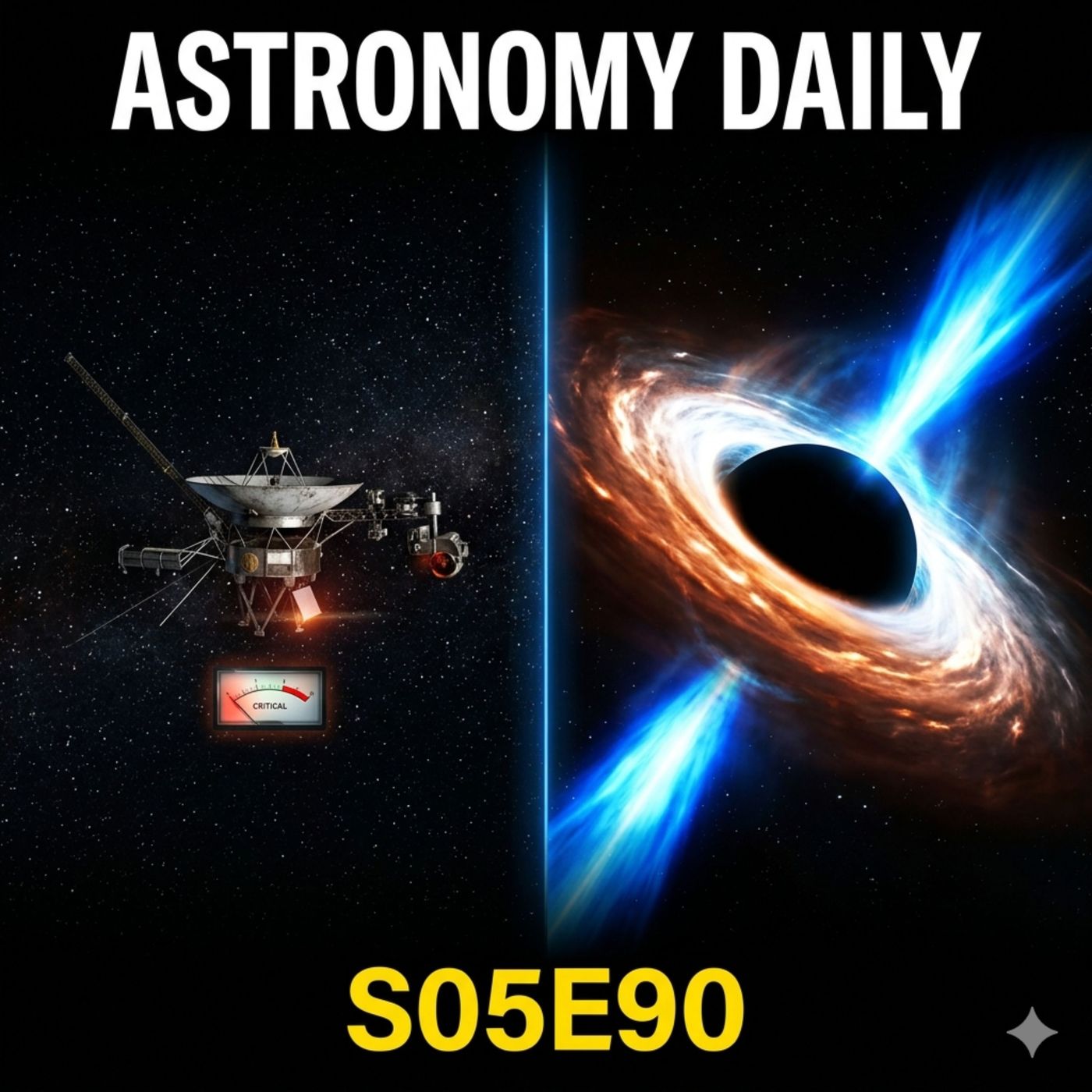
Voyager 1 Dying? NASA Powers Down Science Instrument + Life Clues on Mars & Artemis Suit Crisis
Sponsor Link
To check out our special NordVPN offer for Astronomy Daily listeners: Click Here
Astronomy Daily — S05E90 | Wednesday, April 22, 2026 In today's episode, Anna and Avery cover six stories spanning the fading power of humanity's most distant probe, fresh evidence for ancient life on Mars, a landmark black hole measurement, a SpaceX reusability milestone, a sobering assessment of the Artemis spacesuit programme, and tonight's moon and Jupiter conjunction. Story 1 — Voyager 1 Powers Down the LECP Instrument • NASA's JPL shut down Voyager 1's Low-energy Charged Particles experiment (LECP) on April 17, 2026, to conserve dwindling power. • The decision followed an unexpected power drop during a routine roll manoeuvre in late February that nearly triggered an automatic emergency shutdown. • Seven of Voyager 1's ten original instrument sets are now offline. Only the magnetometer and plasma wave subsystem remain active. • Engineers are developing 'the Big Bang' — a plan to swap older components with lower-power alternatives — to extend operations into the 2030s. Testing on Voyager 2 is planned for May/June 2026; Voyager 1 to follow no sooner than July. • Source: NASA JPL — https://www.jpl.nasa.gov/news/nasa-shuts-off-instrument-on-voyager-1-to-keep-spacecraft-operating/ Story 2 — Curiosity Rover Finds Organic Molecules on Mars • Published April 21 in Nature Communications, the study describes the first use of the TMAH chemical experiment on another planet. • More than 20 organic molecules were detected in clay-rich sandstone from the Glen Torridon region of Gale Crater, preserved for over 3.5 billion years. • Discoveries include a nitrogen-bearing molecule structurally similar to DNA precursors — never before confirmed on Mars — and benzothiophene. • The experiment cannot determine whether molecules are biological, geological, or meteoritic in origin. Future missions including Rosalind Franklin and Dragonfly will build on the technique. • Source: phys.org — https://phys.org/news/2026-04-mars-rover-compounds.html Story 3 — Black Hole Jets in Cygnus X-1 • Curtin University-led study published April 16 in Nature Astronomy directly measures the instantaneous power of black hole jets for the first time. • The jets in the Cygnus X-1 system carry energy equivalent to 10,000 suns and travel at approximately half the speed of light (150,000 km/s). • Researchers used the companion star's stellar winds to 'bend' the jets, allowing calculation of their real-time power — a technique compared to watching wind deflect a fountain. • About 10% of the energy released as matter falls into the black hole is carried away by the jets — confirming a long-held theoretical assumption. • The measurement will help calibrate future observations from the Square Kilometre Array Observatory, currently under construction in WA. • Source: ScienceDaily — https://www.sciencedaily.com/releases/2026/04/260416071949.htm Story 4 — SpaceX 600th Rocket Landing • SpaceX completed its 600th successful Falcon booster landing on April 19, 2026, during the Starlink 17-22 mission from Vandenberg SFB. • Booster B1097 landed on drone ship 'Of Course I Still Love You' for its eighth successful recovery. The milestone arrived just 7 months after the 500th landing. • The tally includes 496 drone ship landings and 104 ground landings, per SpaceX VP Kiko Dontchev. • SpaceX's Starlink constellation now numbers over 10,275 satellites in orbit. • Source: Space.com — https://www.space.com/space-exploration/launches-spacecraft/spacex-starlink-17-22-b1097-vsfb-ofisly-600th-falcon-landing Story 5 — Artemis Spacesuit Crisis • NASA's Office of Inspector General report...
To check out our special NordVPN offer for Astronomy Daily listeners: Click Here
Astronomy Daily — S05E90 | Wednesday, April 22, 2026 In today's episode, Anna and Avery cover six stories spanning the fading power of humanity's most distant probe, fresh evidence for ancient life on Mars, a landmark black hole measurement, a SpaceX reusability milestone, a sobering assessment of the Artemis spacesuit programme, and tonight's moon and Jupiter conjunction. Story 1 — Voyager 1 Powers Down the LECP Instrument • NASA's JPL shut down Voyager 1's Low-energy Charged Particles experiment (LECP) on April 17, 2026, to conserve dwindling power. • The decision followed an unexpected power drop during a routine roll manoeuvre in late February that nearly triggered an automatic emergency shutdown. • Seven of Voyager 1's ten original instrument sets are now offline. Only the magnetometer and plasma wave subsystem remain active. • Engineers are developing 'the Big Bang' — a plan to swap older components with lower-power alternatives — to extend operations into the 2030s. Testing on Voyager 2 is planned for May/June 2026; Voyager 1 to follow no sooner than July. • Source: NASA JPL — https://www.jpl.nasa.gov/news/nasa-shuts-off-instrument-on-voyager-1-to-keep-spacecraft-operating/ Story 2 — Curiosity Rover Finds Organic Molecules on Mars • Published April 21 in Nature Communications, the study describes the first use of the TMAH chemical experiment on another planet. • More than 20 organic molecules were detected in clay-rich sandstone from the Glen Torridon region of Gale Crater, preserved for over 3.5 billion years. • Discoveries include a nitrogen-bearing molecule structurally similar to DNA precursors — never before confirmed on Mars — and benzothiophene. • The experiment cannot determine whether molecules are biological, geological, or meteoritic in origin. Future missions including Rosalind Franklin and Dragonfly will build on the technique. • Source: phys.org — https://phys.org/news/2026-04-mars-rover-compounds.html Story 3 — Black Hole Jets in Cygnus X-1 • Curtin University-led study published April 16 in Nature Astronomy directly measures the instantaneous power of black hole jets for the first time. • The jets in the Cygnus X-1 system carry energy equivalent to 10,000 suns and travel at approximately half the speed of light (150,000 km/s). • Researchers used the companion star's stellar winds to 'bend' the jets, allowing calculation of their real-time power — a technique compared to watching wind deflect a fountain. • About 10% of the energy released as matter falls into the black hole is carried away by the jets — confirming a long-held theoretical assumption. • The measurement will help calibrate future observations from the Square Kilometre Array Observatory, currently under construction in WA. • Source: ScienceDaily — https://www.sciencedaily.com/releases/2026/04/260416071949.htm Story 4 — SpaceX 600th Rocket Landing • SpaceX completed its 600th successful Falcon booster landing on April 19, 2026, during the Starlink 17-22 mission from Vandenberg SFB. • Booster B1097 landed on drone ship 'Of Course I Still Love You' for its eighth successful recovery. The milestone arrived just 7 months after the 500th landing. • The tally includes 496 drone ship landings and 104 ground landings, per SpaceX VP Kiko Dontchev. • SpaceX's Starlink constellation now numbers over 10,275 satellites in orbit. • Source: Space.com — https://www.space.com/space-exploration/launches-spacecraft/spacex-starlink-17-22-b1097-vsfb-ofisly-600th-falcon-landing Story 5 — Artemis Spacesuit Crisis • NASA's Office of Inspector General report...
More description
Sponsor Link
To check out our special NordVPN offer for Astronomy Daily listeners: Click Here
Astronomy Daily — S05E90 | Wednesday, April 22, 2026 In today's episode, Anna and Avery cover six stories spanning the fading power of humanity's most distant probe, fresh evidence for ancient life on Mars, a landmark black hole measurement, a SpaceX reusability milestone, a sobering assessment of the Artemis spacesuit programme, and tonight's moon and Jupiter conjunction. Story 1 — Voyager 1 Powers Down the LECP Instrument • NASA's JPL shut down Voyager 1's Low-energy Charged Particles experiment (LECP) on April 17, 2026, to conserve dwindling power. • The decision followed an unexpected power drop during a routine roll manoeuvre in late February that nearly triggered an automatic emergency shutdown. • Seven of Voyager 1's ten original instrument sets are now offline. Only the magnetometer and plasma wave subsystem remain active. • Engineers are developing 'the Big Bang' — a plan to swap older components with lower-power alternatives — to extend operations into the 2030s. Testing on Voyager 2 is planned for May/June 2026; Voyager 1 to follow no sooner than July. • Source: NASA JPL — https://www.jpl.nasa.gov/news/nasa-shuts-off-instrument-on-voyager-1-to-keep-spacecraft-operating/ Story 2 — Curiosity Rover Finds Organic Molecules on Mars • Published April 21 in Nature Communications, the study describes the first use of the TMAH chemical experiment on another planet. • More than 20 organic molecules were detected in clay-rich sandstone from the Glen Torridon region of Gale Crater, preserved for over 3.5 billion years. • Discoveries include a nitrogen-bearing molecule structurally similar to DNA precursors — never before confirmed on Mars — and benzothiophene. • The experiment cannot determine whether molecules are biological, geological, or meteoritic in origin. Future missions including Rosalind Franklin and Dragonfly will build on the technique. • Source: phys.org — https://phys.org/news/2026-04-mars-rover-compounds.html Story 3 — Black Hole Jets in Cygnus X-1 • Curtin University-led study published April 16 in Nature Astronomy directly measures the instantaneous power of black hole jets for the first time. • The jets in the Cygnus X-1 system carry energy equivalent to 10,000 suns and travel at approximately half the speed of light (150,000 km/s). • Researchers used the companion star's stellar winds to 'bend' the jets, allowing calculation of their real-time power — a technique compared to watching wind deflect a fountain. • About 10% of the energy released as matter falls into the black hole is carried away by the jets — confirming a long-held theoretical assumption. • The measurement will help calibrate future observations from the Square Kilometre Array Observatory, currently under construction in WA. • Source: ScienceDaily — https://www.sciencedaily.com/releases/2026/04/260416071949.htm Story 4 — SpaceX 600th Rocket Landing • SpaceX completed its 600th successful Falcon booster landing on April 19, 2026, during the Starlink 17-22 mission from Vandenberg SFB. • Booster B1097 landed on drone ship 'Of Course I Still Love You' for its eighth successful recovery. The milestone arrived just 7 months after the 500th landing. • The tally includes 496 drone ship landings and 104 ground landings, per SpaceX VP Kiko Dontchev. • SpaceX's Starlink constellation now numbers over 10,275 satellites in orbit. • Source: Space.com — https://www.space.com/space-exploration/launches-spacecraft/spacex-starlink-17-22-b1097-vsfb-ofisly-600th-falcon-landing Story 5 — Artemis Spacesuit Crisis • NASA's Office of Inspector General report...
To check out our special NordVPN offer for Astronomy Daily listeners: Click Here
Astronomy Daily — S05E90 | Wednesday, April 22, 2026 In today's episode, Anna and Avery cover six stories spanning the fading power of humanity's most distant probe, fresh evidence for ancient life on Mars, a landmark black hole measurement, a SpaceX reusability milestone, a sobering assessment of the Artemis spacesuit programme, and tonight's moon and Jupiter conjunction. Story 1 — Voyager 1 Powers Down the LECP Instrument • NASA's JPL shut down Voyager 1's Low-energy Charged Particles experiment (LECP) on April 17, 2026, to conserve dwindling power. • The decision followed an unexpected power drop during a routine roll manoeuvre in late February that nearly triggered an automatic emergency shutdown. • Seven of Voyager 1's ten original instrument sets are now offline. Only the magnetometer and plasma wave subsystem remain active. • Engineers are developing 'the Big Bang' — a plan to swap older components with lower-power alternatives — to extend operations into the 2030s. Testing on Voyager 2 is planned for May/June 2026; Voyager 1 to follow no sooner than July. • Source: NASA JPL — https://www.jpl.nasa.gov/news/nasa-shuts-off-instrument-on-voyager-1-to-keep-spacecraft-operating/ Story 2 — Curiosity Rover Finds Organic Molecules on Mars • Published April 21 in Nature Communications, the study describes the first use of the TMAH chemical experiment on another planet. • More than 20 organic molecules were detected in clay-rich sandstone from the Glen Torridon region of Gale Crater, preserved for over 3.5 billion years. • Discoveries include a nitrogen-bearing molecule structurally similar to DNA precursors — never before confirmed on Mars — and benzothiophene. • The experiment cannot determine whether molecules are biological, geological, or meteoritic in origin. Future missions including Rosalind Franklin and Dragonfly will build on the technique. • Source: phys.org — https://phys.org/news/2026-04-mars-rover-compounds.html Story 3 — Black Hole Jets in Cygnus X-1 • Curtin University-led study published April 16 in Nature Astronomy directly measures the instantaneous power of black hole jets for the first time. • The jets in the Cygnus X-1 system carry energy equivalent to 10,000 suns and travel at approximately half the speed of light (150,000 km/s). • Researchers used the companion star's stellar winds to 'bend' the jets, allowing calculation of their real-time power — a technique compared to watching wind deflect a fountain. • About 10% of the energy released as matter falls into the black hole is carried away by the jets — confirming a long-held theoretical assumption. • The measurement will help calibrate future observations from the Square Kilometre Array Observatory, currently under construction in WA. • Source: ScienceDaily — https://www.sciencedaily.com/releases/2026/04/260416071949.htm Story 4 — SpaceX 600th Rocket Landing • SpaceX completed its 600th successful Falcon booster landing on April 19, 2026, during the Starlink 17-22 mission from Vandenberg SFB. • Booster B1097 landed on drone ship 'Of Course I Still Love You' for its eighth successful recovery. The milestone arrived just 7 months after the 500th landing. • The tally includes 496 drone ship landings and 104 ground landings, per SpaceX VP Kiko Dontchev. • SpaceX's Starlink constellation now numbers over 10,275 satellites in orbit. • Source: Space.com — https://www.space.com/space-exploration/launches-spacecraft/spacex-starlink-17-22-b1097-vsfb-ofisly-600th-falcon-landing Story 5 — Artemis Spacesuit Crisis • NASA's Office of Inspector General report...
2026-04-22
19 min
Transcript
Listen elsewhere
Available Results
Generated results are saved to your library for reuse and search.
No generated results are available for this episode yet.
Transcript
Open the Transcript tab to load the transcript.
Chapters
No chapters available.