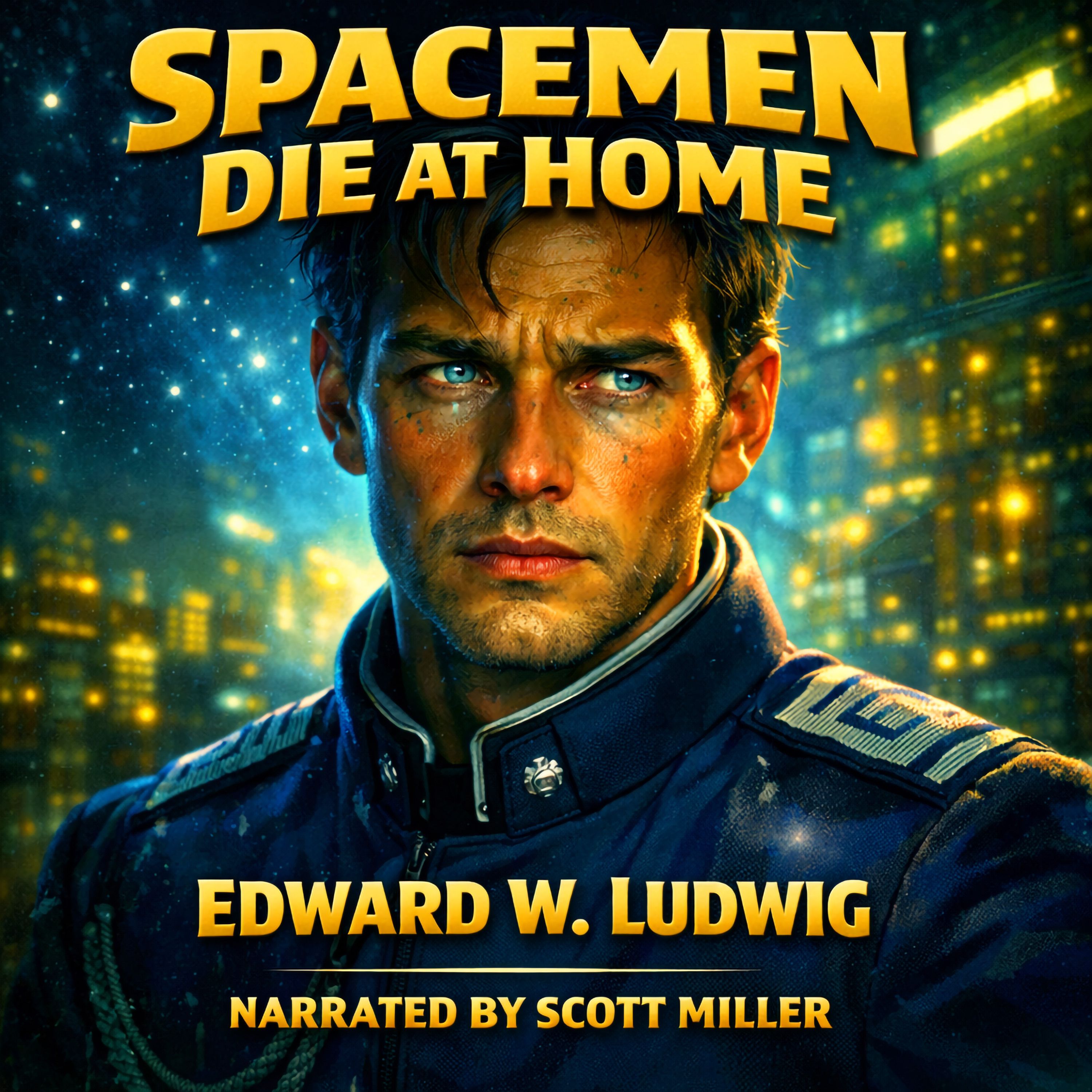
Spacemen Die at Home by Edward W. Ludwig - Exile among the stars, or sanctuary beyond Earth? One man’s freedom is another’s cage.
One man's retreat is another's prison... and it takes a heap of flying to make a hulk a home! Spacemen Die At Home by Edward W. Ludwig, that’s next on The Lost Sci-Fi Podcast, with at least one lost vintage sci-fi short story in every episode.
We appreciate your 5-star reviews on Apple Podcasts. Gtree10 says. “Always a joy when a new story drops. Such a wonderful podcast, being able to listen to these great lost sci-fi stories from a range of authors (some well-know, some unknown). The reader does an incredible job bringing the stories to life. I eagerly look forward to next show dropping."
Thank you Gtree10!!
Kaydon Tye says, “A must listen to for sci-fi fans! I found the lost sci-fi podcast shortly after having a conversation about Philip K Dick with the attendant at the Holter Museum of Art in Helena Montana and looked for more about him. Being a big fan of classic and vintage literature I was pleasantly surprised to find your podcast. I was thrilled to see Philip K Dick as the pilot episode. I’ve been enjoying the narrator bring to life the story like an old time radio drama. From “The Plagiarist of Rigel IV” to “The Mind Digger” I hang on to every word to the end. I give the sci-fi podcast five stars and say it is a must listen for sci-fi fans.”
Thanks Kaydon Tye!!
If you like what we’re doing you can help us by leaving a 5 Star review, if you think we deserve it, on Apple Podcasts. Or you can give us 5 stars on Spotify.
Born in Tracy, California in July 1920, Edward William Ludwig had 16 short science fiction stories published in the 1950s, 6 in the 60s, 1 in the 70s and 2 short sci-fi stories in the 80s. We know he died in 1990 at the age of 69 and that’s about it.
The story we’re about to hear was his 5th published story in the 1950s. Turn to page 75 in the October 1951 issue of Galaxy Science Fiction Magazine for Spacemen Die At Home by Edward W. Ludwig…
Next week on The Lost Sci-Fi Podcast, The most dangerous game, said one writer, is Man. But there is another still more deadly! Seventh Victim by Robert Sheckley. That’s next week on The Lost Sci-Fi Podcast, with at least one lost vintage sci-fi short story in every episode.
If you like vintage science fiction stories from Philip K. Dick, Isaac Asimov, H.G. Wells, Harlan Ellison and others, you will love The Lost Sci-Fi Podcast!
Listen without commercials and enjoy exclusive bonus episodes every month with Lost Sci-Fi Premium—start your free 7-day trial today. https://lostscifi.supercast.com/
Hosted by Simplecast, an AdsWizz company. See pcm.adswizz.com for information about our collection and use of personal data for advertising.
Available Results
Generated results are saved to your library for reuse and search.
Choose Template
Pick the result you want. You can review provider and model before generating.
A concise first-pass summary for understanding the episode quickly.
A comprehensive, source-grounded extraction of the reusable knowledge in an episode.
A comprehensive extraction focused on opportunities, strategy, markets, and company building.
Explicit actions, next steps, habits, recommendations, and things to avoid.
Repeatable methods, frameworks, mental models, processes, and systems.
A dedicated inventory of concrete resources named in the episode.
A concise first-pass summary for understanding the episode quickly.
A detailed readable summary organized by chapter or topic.
A navigable map of subjects, topic flow, and suggested chapters.
A comprehensive, source-grounded extraction of the reusable knowledge in an episode.
Reusable atomic knowledge units extracted from the episode.
A comprehensive extraction focused on health practices, protocols, claims, and safety caveats.
A comprehensive extraction focused on opportunities, strategy, markets, and company building.
Explicit actions, next steps, habits, recommendations, and things to avoid.
A dedicated inventory of concrete resources named in the episode.
A dedicated analysis of warnings, limitations, trade-offs, weak evidence, and uncertainty.
A concise first-pass summary for understanding the episode quickly.
A detailed readable summary organized by chapter or topic.
A navigable map of subjects, topic flow, and suggested chapters.
A comprehensive, source-grounded extraction of the reusable knowledge in an episode.
Reusable atomic knowledge units extracted from the episode.
A comprehensive extraction focused on health practices, protocols, claims, and safety caveats.
A comprehensive extraction focused on opportunities, strategy, markets, and company building.
Scientific findings, mechanisms, studies, hypotheses, and the limits of the evidence discussed.
Technologies, AI models, technical methods, capabilities, limitations, and adoption implications.
Investment theses, assets, catalysts, valuation reasoning, time horizons, and risks.
Chronologies, actors, causes, consequences, turning points, and competing historical interpretations.
Policies, proposals, stakeholders, arguments, implementation constraints, and predicted effects.
Career paths, skills, hiring signals, workplace decisions, transitions, and limitations of the advice.
Behavioral mechanisms, biases, motivation, habits, emotions, interventions, and evidence limitations.
Economic mechanisms, incentives, indicators, market structure, forecasts, and uncertainty.
Leadership principles, team systems, organizational design, culture, feedback, and failure modes.
Audience, positioning, messaging, acquisition, retention, experiments, metrics, and failed approaches.
Teaching methods, learning strategies, practice, feedback, assessment, and effectiveness evidence.
Theses, premises, arguments, objections, values, thought experiments, and unresolved questions.
Communication patterns, conflict, boundaries, expectations, repair methods, and contextual limitations.
Books, papers, authors, courses, and other learning resources mentioned in the episode.
Repeatable methods, frameworks, mental models, processes, and systems.
Explicit actions, next steps, habits, recommendations, and things to avoid.
Memorable statements and important claims with attribution and source context.
A dedicated inventory of concrete resources named in the episode.
A dedicated analysis of warnings, limitations, trade-offs, weak evidence, and uncertainty.