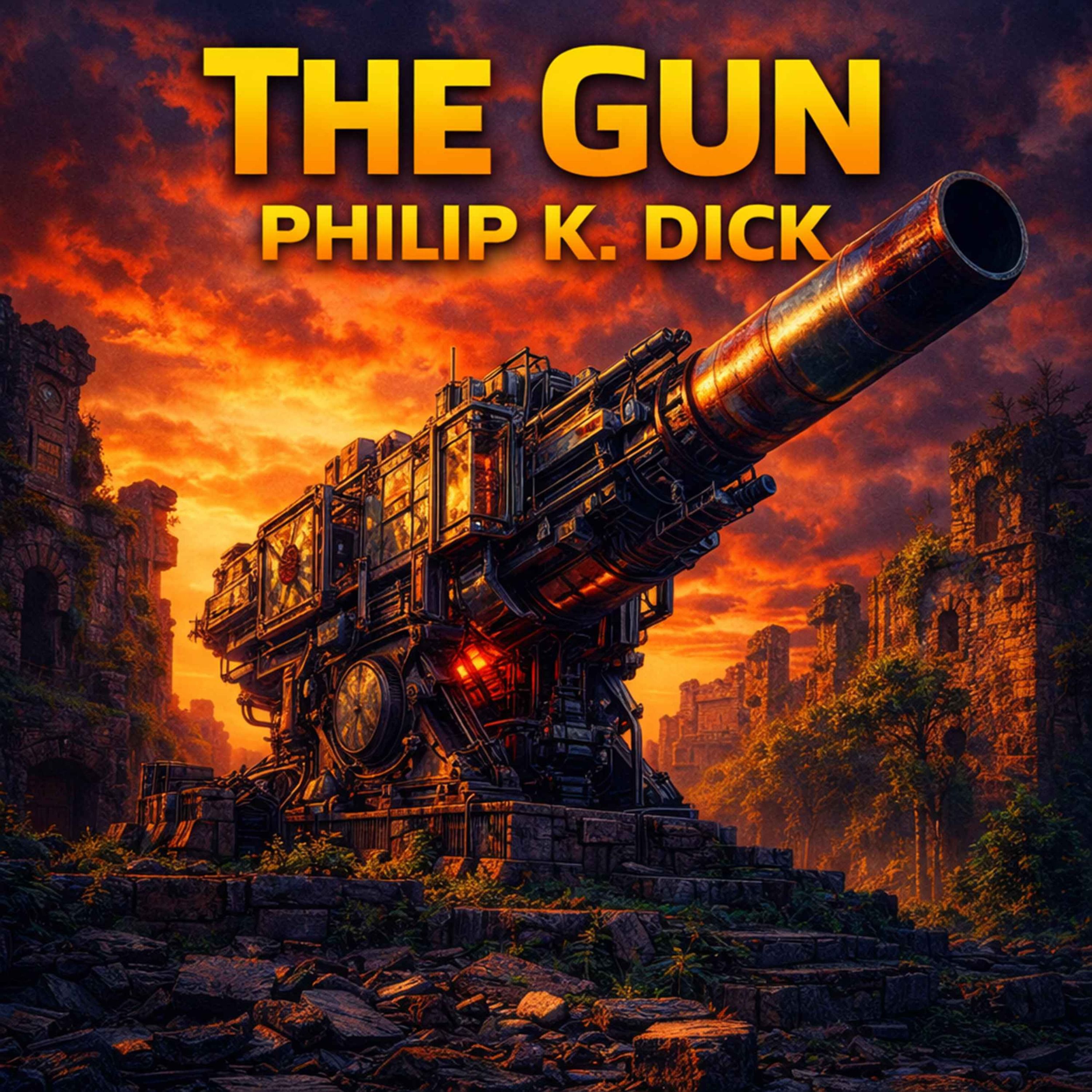
The Gun by Philip K. Dick - Philip K. Dick Short Stories
Nothing moved or stirred. Everything was silent, dead. Only the gun showed signs of life ... and the trespassers had wrecked that for all time. The return journey to pick up the treasure would be a cinch ... they smiled. The Gun by Philip K. Dick, that’s next on The Lost Sci-Fi Podcast, with at least one lost vintage sci-fi short story in every episode.
In the last week we have added hundreds of new listeners all over the world and last week’s episode featuring The Creatures That Time Forgot by Ray Bradbury had more listeners in its first week, by far, than any other episode of the Lost Sci-Fi Podcast. Thank you for making that happen.
Our story comes from Planet Stories magazine in September 1952. More space on the cover is devoted to author Mark Ganes and his feature story Evil Out of Onzar than any other story that appeared in the magazine. Who is Mark Ganes? I don’t know. I couldn’t find any information about him, nor could I find any other story that he’d ever written. The cover lists five of the seven authors in the issue. One of the guys who wasn’t mentioned. A relatively unknown author, at the time, named Philip K. Dick. Turn to page 46 for The Gun…
Next week on The Lost Sci-Fi Podcast, There was a reason why his scripts were smash hits—they had realism. And why not? He was reliving every scene and emotion in them! The Mind Digger by Winston Marks... that’s next week on The Lost Sci-Fi Podcast, with at least one lost vintage sci-fi short story in every episode.
https://lostscifi.com/podcast/the-gun-by-philip-k-dick-episode-77/
Listen without commercials and enjoy exclusive bonus episodes every month with Lost Sci-Fi Premium—start your free 7-day trial today. https://lostscifi.supercast.com/
Hosted by Simplecast, an AdsWizz company. See pcm.adswizz.com for information about our collection and use of personal data for advertising.
Available Results
Generated results are saved to your library for reuse and search.
Choose Template
Pick the result you want. You can review provider and model before generating.
A concise first-pass summary for understanding the episode quickly.
A comprehensive, source-grounded extraction of the reusable knowledge in an episode.
A comprehensive extraction focused on opportunities, strategy, markets, and company building.
Explicit actions, next steps, habits, recommendations, and things to avoid.
Repeatable methods, frameworks, mental models, processes, and systems.
A dedicated inventory of concrete resources named in the episode.
A concise first-pass summary for understanding the episode quickly.
A detailed readable summary organized by chapter or topic.
A navigable map of subjects, topic flow, and suggested chapters.
A comprehensive, source-grounded extraction of the reusable knowledge in an episode.
Reusable atomic knowledge units extracted from the episode.
A comprehensive extraction focused on health practices, protocols, claims, and safety caveats.
A comprehensive extraction focused on opportunities, strategy, markets, and company building.
Explicit actions, next steps, habits, recommendations, and things to avoid.
A dedicated inventory of concrete resources named in the episode.
A dedicated analysis of warnings, limitations, trade-offs, weak evidence, and uncertainty.
A concise first-pass summary for understanding the episode quickly.
A detailed readable summary organized by chapter or topic.
A navigable map of subjects, topic flow, and suggested chapters.
A comprehensive, source-grounded extraction of the reusable knowledge in an episode.
Reusable atomic knowledge units extracted from the episode.
A comprehensive extraction focused on health practices, protocols, claims, and safety caveats.
A comprehensive extraction focused on opportunities, strategy, markets, and company building.
Scientific findings, mechanisms, studies, hypotheses, and the limits of the evidence discussed.
Technologies, AI models, technical methods, capabilities, limitations, and adoption implications.
Investment theses, assets, catalysts, valuation reasoning, time horizons, and risks.
Chronologies, actors, causes, consequences, turning points, and competing historical interpretations.
Policies, proposals, stakeholders, arguments, implementation constraints, and predicted effects.
Career paths, skills, hiring signals, workplace decisions, transitions, and limitations of the advice.
Behavioral mechanisms, biases, motivation, habits, emotions, interventions, and evidence limitations.
Economic mechanisms, incentives, indicators, market structure, forecasts, and uncertainty.
Leadership principles, team systems, organizational design, culture, feedback, and failure modes.
Audience, positioning, messaging, acquisition, retention, experiments, metrics, and failed approaches.
Teaching methods, learning strategies, practice, feedback, assessment, and effectiveness evidence.
Theses, premises, arguments, objections, values, thought experiments, and unresolved questions.
Communication patterns, conflict, boundaries, expectations, repair methods, and contextual limitations.
Books, papers, authors, courses, and other learning resources mentioned in the episode.
Repeatable methods, frameworks, mental models, processes, and systems.
Explicit actions, next steps, habits, recommendations, and things to avoid.
Memorable statements and important claims with attribution and source context.
A dedicated inventory of concrete resources named in the episode.
A dedicated analysis of warnings, limitations, trade-offs, weak evidence, and uncertainty.