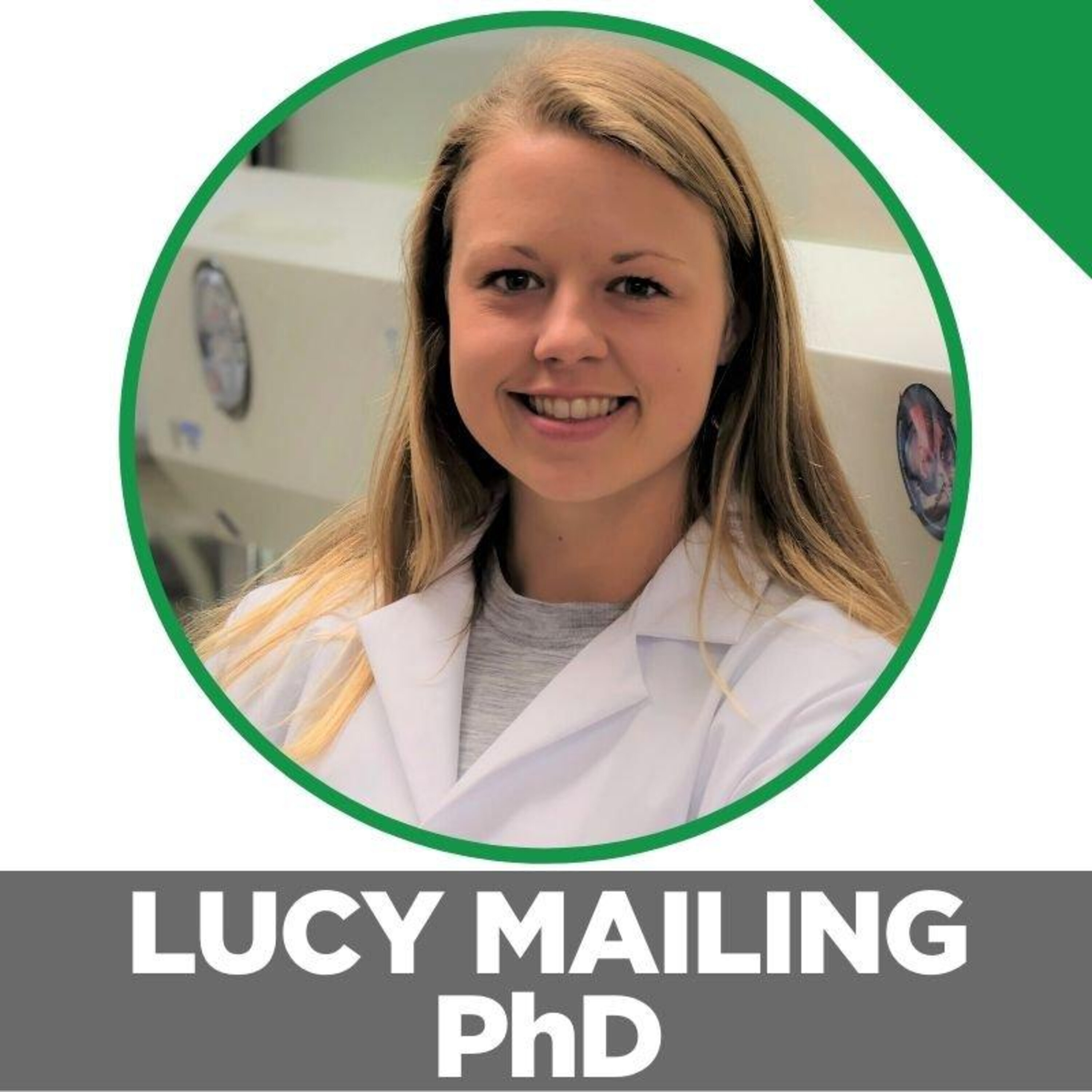
Is A Ketogenic Diet Bad For Your Gut, Should You Eat Resistant Starch, How Exercise Changes Your Gut Bacteria & Much More With Lucy Mailing.
bengreenfieldfitness.com/lucymailing
My guest on today's show, Lucy Mailing, PhD is a microbiome researcher, educator, and passionate scholar of integrative, evidence-based gut health. Lucy received her bachelor’s in Biology from Kalamazoo College in 2015 and her PhD in Nutritional Sciences from the University of Illinois in 2019, where her graduate research focused on the impact of diet and exercise on the gut microbiota.
She has authored numerous peer-reviewed journal articles, regularly presents at national and international conferences, and was named an Emerging Leader in Nutritional Sciences by the American Society for Nutrition in 2017. Lucy is the founder and sole author of lucymailing.com, a website dedicated to integrative, evidence-based articles about the gut microbiome, health, and nutrition science.
During our discussion, you'll discover: -Why Lucy usually skips breakfast in the morning...6:25
-How Lucy developed her interest in the workings of the gut...9:35
-The oxygen/gut dysbiosis connection...14:35
-How to test butyrate levels and hypoxic status...21:40
-Other ways to support gut hypoxia and PPAR gamma activation...25:55
-Why the paradigm of how we view SIBO has been misguided...31:15
-Whether a ketogenic diet is good or bad for the gut...37:35 -How exercise impacts the gut microbiome...45:50
-Resistant starch and gut health...54:45
-What Lucy is excited about regarding gut health research...1:00:30
-And much more!
Episode sponsors: Kion Creatine, JOOVV, Paleo Valley, CAR.O.L
bengreenfieldfitness.com/lucymailing
See omnystudio.com/listener for privacy information.
Available Results
Generated results are saved to your library for reuse and search.
Choose Template
Pick the result you want. You can review provider and model before generating.
A concise first-pass summary for understanding the episode quickly.
A comprehensive, source-grounded extraction of the reusable knowledge in an episode.
A comprehensive extraction focused on health practices, protocols, claims, and safety caveats.
A dedicated analysis of warnings, limitations, trade-offs, weak evidence, and uncertainty.
Repeatable methods, frameworks, mental models, processes, and systems.
A comprehensive extraction focused on opportunities, strategy, markets, and company building.
A concise first-pass summary for understanding the episode quickly.
A detailed readable summary organized by chapter or topic.
A navigable map of subjects, topic flow, and suggested chapters.
A comprehensive, source-grounded extraction of the reusable knowledge in an episode.
Reusable atomic knowledge units extracted from the episode.
A comprehensive extraction focused on health practices, protocols, claims, and safety caveats.
A comprehensive extraction focused on opportunities, strategy, markets, and company building.
Explicit actions, next steps, habits, recommendations, and things to avoid.
A dedicated inventory of concrete resources named in the episode.
A dedicated analysis of warnings, limitations, trade-offs, weak evidence, and uncertainty.
A concise first-pass summary for understanding the episode quickly.
A detailed readable summary organized by chapter or topic.
A navigable map of subjects, topic flow, and suggested chapters.
A comprehensive, source-grounded extraction of the reusable knowledge in an episode.
Reusable atomic knowledge units extracted from the episode.
A comprehensive extraction focused on health practices, protocols, claims, and safety caveats.
A comprehensive extraction focused on opportunities, strategy, markets, and company building.
Scientific findings, mechanisms, studies, hypotheses, and the limits of the evidence discussed.
Technologies, AI models, technical methods, capabilities, limitations, and adoption implications.
Investment theses, assets, catalysts, valuation reasoning, time horizons, and risks.
Chronologies, actors, causes, consequences, turning points, and competing historical interpretations.
Policies, proposals, stakeholders, arguments, implementation constraints, and predicted effects.
Career paths, skills, hiring signals, workplace decisions, transitions, and limitations of the advice.
Behavioral mechanisms, biases, motivation, habits, emotions, interventions, and evidence limitations.
Economic mechanisms, incentives, indicators, market structure, forecasts, and uncertainty.
Leadership principles, team systems, organizational design, culture, feedback, and failure modes.
Audience, positioning, messaging, acquisition, retention, experiments, metrics, and failed approaches.
Teaching methods, learning strategies, practice, feedback, assessment, and effectiveness evidence.
Theses, premises, arguments, objections, values, thought experiments, and unresolved questions.
Communication patterns, conflict, boundaries, expectations, repair methods, and contextual limitations.
Books, papers, authors, courses, and other learning resources mentioned in the episode.
Repeatable methods, frameworks, mental models, processes, and systems.
Explicit actions, next steps, habits, recommendations, and things to avoid.
Memorable statements and important claims with attribution and source context.
A dedicated inventory of concrete resources named in the episode.
A dedicated analysis of warnings, limitations, trade-offs, weak evidence, and uncertainty.