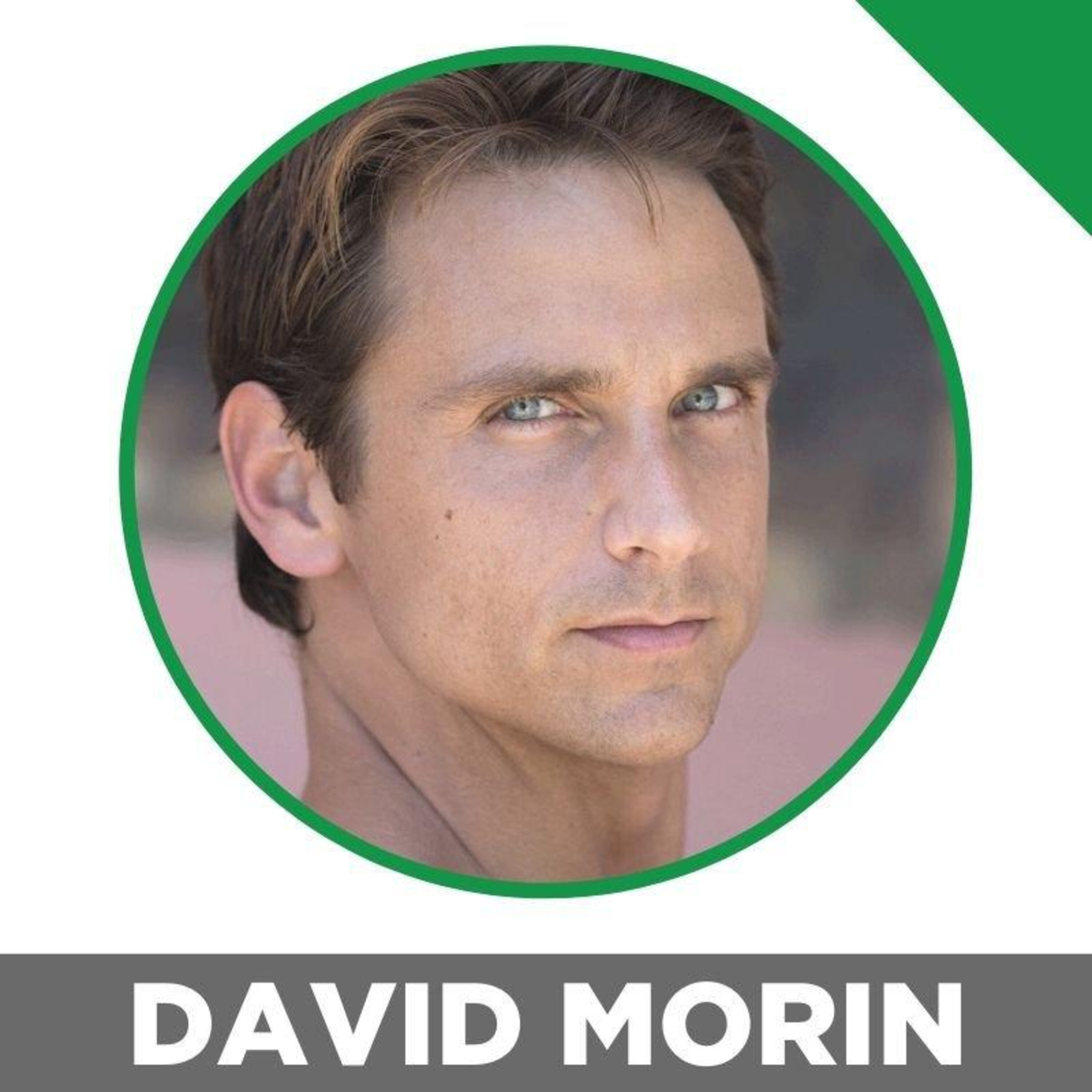
How You Really Lose Fat (You'll Be Surprised), How To Enhance Fat Loss Using Simple Breath Tactics, Plus Near Death Experiences, Psychedelics & More!.
In the past, I've discussed the link between respiration and body fat in articles such as "The 2 Best Ways To Burn Fat Fast (Without Destroying Your Hormones Or Metabolism)" and on the podcast "16 Reasons You’re Not Burning Fat (& How To Lose Weight The Right Way)."
But my friend and former podcast guest Adam Wenguer recently introduced me to a guy who has thoroughly studied the link between breath and fat loss, and he has some very interesting insights on the matter as well as some potent fat loss tips you may find quite handy. His name is David Morin.
David is a German-born American fitness trainer, model, corporate wellness speaker, and entrepreneur. An accredited strength and conditioning trainer and coach with 16 years of experience, David's clients include everyone from folks in the U.S. Special Forces to NBA stars like Allen Iverson. His skill set continues to evolve through various modalities rooted in movement, martial arts, Chi Kung, mediation, biofeedback, free-weight training, HIIT, and advanced biohacking techniques.
He has appeared on more than 30 fitness magazine covers, including Muscle & Fitness, FitnessRX, Men’s Health, and Ironman magazine. For over 10 years and in 15 countries, David has been featured over 100 times as an editorial contributor and instructional fitness model for print media. Not to mention, he has hosted a number of successful fitness product infomercials. David joined “A-list celebrity” Rebel Wilson for a six-page editorial inside Glamour Magazine recently and can be found in advertisements on the internet and in print and billboards around the world representing his supplement partner Dymatize. David can also be seen in the documentary The Perfect Physique as well as working on director Micheal Bay's film “Pain & Gain” with The Rock and Mark Wahlberg.
As a father of four who likes to stay active, David took matters into his own hands to create an effective, efficient at-home training regime called Lynx Fitness. As a corporate wellness speaker for clients such as Bank United and Post Holdings, David covers nutritional topics, practical guides to better health, DNA-test-specific nutrient selection, and behavioral pattern course correction towards higher productivity and health.
Finally, David created FLO2 essential oils for "sniffing" pre-workout, and I have to admit, since David sent me some after this podcast and I began to use them, they are now my preferred alternative to full-on "smelling salts" for hard workouts. I recommend you try them for yourself. You can click here to get FLO2, and use code BENFLO to save 25%.
See omnystudio.com/listener for privacy information.
Available Results
Generated results are saved to your library for reuse and search.
Choose Template
Pick the result you want. You can review provider and model before generating.
A concise first-pass summary for understanding the episode quickly.
A comprehensive, source-grounded extraction of the reusable knowledge in an episode.
A comprehensive extraction focused on health practices, protocols, claims, and safety caveats.
A dedicated analysis of warnings, limitations, trade-offs, weak evidence, and uncertainty.
Repeatable methods, frameworks, mental models, processes, and systems.
Technologies, AI models, technical methods, capabilities, limitations, and adoption implications.
A concise first-pass summary for understanding the episode quickly.
A detailed readable summary organized by chapter or topic.
A navigable map of subjects, topic flow, and suggested chapters.
A comprehensive, source-grounded extraction of the reusable knowledge in an episode.
Reusable atomic knowledge units extracted from the episode.
A comprehensive extraction focused on health practices, protocols, claims, and safety caveats.
A comprehensive extraction focused on opportunities, strategy, markets, and company building.
Explicit actions, next steps, habits, recommendations, and things to avoid.
A dedicated inventory of concrete resources named in the episode.
A dedicated analysis of warnings, limitations, trade-offs, weak evidence, and uncertainty.
A concise first-pass summary for understanding the episode quickly.
A detailed readable summary organized by chapter or topic.
A navigable map of subjects, topic flow, and suggested chapters.
A comprehensive, source-grounded extraction of the reusable knowledge in an episode.
Reusable atomic knowledge units extracted from the episode.
A comprehensive extraction focused on health practices, protocols, claims, and safety caveats.
A comprehensive extraction focused on opportunities, strategy, markets, and company building.
Scientific findings, mechanisms, studies, hypotheses, and the limits of the evidence discussed.
Technologies, AI models, technical methods, capabilities, limitations, and adoption implications.
Investment theses, assets, catalysts, valuation reasoning, time horizons, and risks.
Chronologies, actors, causes, consequences, turning points, and competing historical interpretations.
Policies, proposals, stakeholders, arguments, implementation constraints, and predicted effects.
Career paths, skills, hiring signals, workplace decisions, transitions, and limitations of the advice.
Behavioral mechanisms, biases, motivation, habits, emotions, interventions, and evidence limitations.
Economic mechanisms, incentives, indicators, market structure, forecasts, and uncertainty.
Leadership principles, team systems, organizational design, culture, feedback, and failure modes.
Audience, positioning, messaging, acquisition, retention, experiments, metrics, and failed approaches.
Teaching methods, learning strategies, practice, feedback, assessment, and effectiveness evidence.
Theses, premises, arguments, objections, values, thought experiments, and unresolved questions.
Communication patterns, conflict, boundaries, expectations, repair methods, and contextual limitations.
Books, papers, authors, courses, and other learning resources mentioned in the episode.
Repeatable methods, frameworks, mental models, processes, and systems.
Explicit actions, next steps, habits, recommendations, and things to avoid.
Memorable statements and important claims with attribution and source context.
A dedicated inventory of concrete resources named in the episode.
A dedicated analysis of warnings, limitations, trade-offs, weak evidence, and uncertainty.