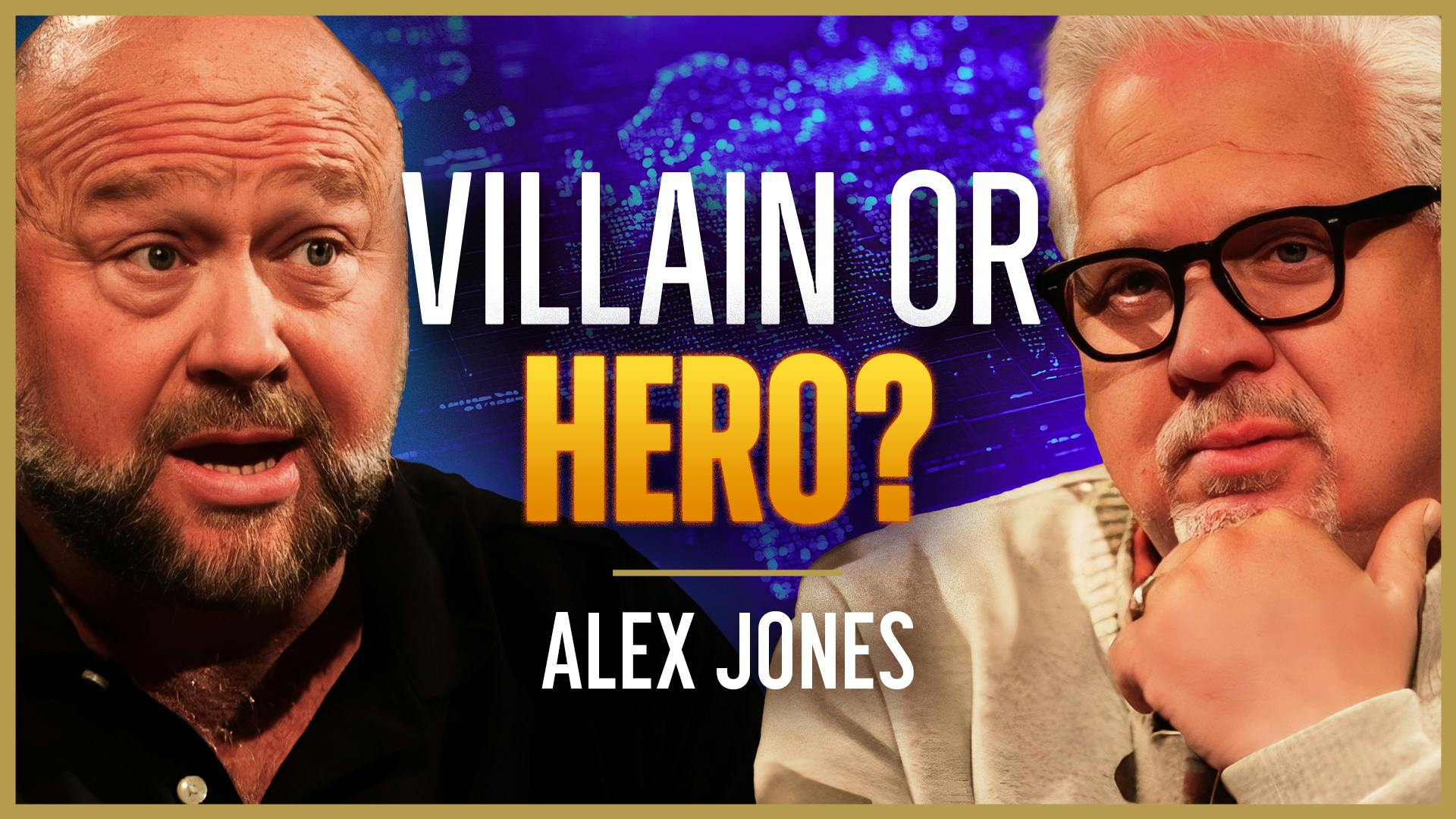
The Untold Story of Alex Jones | Ep 227 | The Glenn Beck Podcast
Nobody is neutral on Alex Jones. He’s either loved or hated. He’s either a villain or a hero. But underneath the labels, who is he really? In this episode of "The Glenn Beck Podcast," Glenn asks Alex the questions “people never ask.” A native Texan, Alex admits that after 50 years, he’s much more introspective. In his youth, puberty turned him from a “bookworm to a hellion,” and his fighting streak landed him in a juvenile detention center. Alex fills in the details of the little-known stories between his childhood and the infamous moment he snuck into the Bohemian Grove to document its eerie “cremation of care” ceremony, which Alex describes as a “little like an art festival” but also “cultic.” Alex’s family's involvement in what he describes as “clandestine stuff” inspired a curiosity about the “corporate dinosaur deep state" that led to a skepticism that has defined his career, including his controversial questioning of 9/11. In a vulnerable discussion about his regrets, Alex admits to a period of time after Trump began his run for president when he was drunk on his show “at least once a week,” and he reveals if he would have considered any penalty fair in the Sandy Hook defamation case.
Is Alex Jones a hero or a villain? In the end, you’ll have to decide for yourself.
Sponsors
Relief Factor
Relief Factor can help you live pain-free!
Visit https://ReliefFactor.com or call 800-4-RELIEF to save on your first order.
PreBorn
By introducing an expecting mother to her unborn baby through a free ultrasound, PreBorn doubles the chances that she will choose life. One lifesaving ultrasound is just $28. To donate securely, dial #250 and say the keyword “Baby,” or visit https://Preborn.com/Glenn
Better Spectacles
Go to https://BetterSpectacles.com/BECK and get your Rodenstock biometric intelligence glasses for 61% off.
Learn more about your ad choices. Visit megaphone.fm/adchoices
Available Results
Generated results are saved to your library for reuse and search.
Choose Template
Pick the result you want. You can review provider and model before generating.
A concise first-pass summary for understanding the episode quickly.
A comprehensive, source-grounded extraction of the reusable knowledge in an episode.
Technologies, AI models, technical methods, capabilities, limitations, and adoption implications.
Repeatable methods, frameworks, mental models, processes, and systems.
A dedicated analysis of warnings, limitations, trade-offs, weak evidence, and uncertainty.
A dedicated inventory of concrete resources named in the episode.
A concise first-pass summary for understanding the episode quickly.
A detailed readable summary organized by chapter or topic.
A navigable map of subjects, topic flow, and suggested chapters.
A comprehensive, source-grounded extraction of the reusable knowledge in an episode.
Reusable atomic knowledge units extracted from the episode.
A comprehensive extraction focused on health practices, protocols, claims, and safety caveats.
A comprehensive extraction focused on opportunities, strategy, markets, and company building.
Explicit actions, next steps, habits, recommendations, and things to avoid.
A dedicated inventory of concrete resources named in the episode.
A dedicated analysis of warnings, limitations, trade-offs, weak evidence, and uncertainty.
A concise first-pass summary for understanding the episode quickly.
A detailed readable summary organized by chapter or topic.
A navigable map of subjects, topic flow, and suggested chapters.
A comprehensive, source-grounded extraction of the reusable knowledge in an episode.
Reusable atomic knowledge units extracted from the episode.
A comprehensive extraction focused on health practices, protocols, claims, and safety caveats.
A comprehensive extraction focused on opportunities, strategy, markets, and company building.
Scientific findings, mechanisms, studies, hypotheses, and the limits of the evidence discussed.
Technologies, AI models, technical methods, capabilities, limitations, and adoption implications.
Investment theses, assets, catalysts, valuation reasoning, time horizons, and risks.
Chronologies, actors, causes, consequences, turning points, and competing historical interpretations.
Policies, proposals, stakeholders, arguments, implementation constraints, and predicted effects.
Career paths, skills, hiring signals, workplace decisions, transitions, and limitations of the advice.
Behavioral mechanisms, biases, motivation, habits, emotions, interventions, and evidence limitations.
Economic mechanisms, incentives, indicators, market structure, forecasts, and uncertainty.
Leadership principles, team systems, organizational design, culture, feedback, and failure modes.
Audience, positioning, messaging, acquisition, retention, experiments, metrics, and failed approaches.
Teaching methods, learning strategies, practice, feedback, assessment, and effectiveness evidence.
Theses, premises, arguments, objections, values, thought experiments, and unresolved questions.
Communication patterns, conflict, boundaries, expectations, repair methods, and contextual limitations.
Books, papers, authors, courses, and other learning resources mentioned in the episode.
Repeatable methods, frameworks, mental models, processes, and systems.
Explicit actions, next steps, habits, recommendations, and things to avoid.
Memorable statements and important claims with attribution and source context.
A dedicated inventory of concrete resources named in the episode.
A dedicated analysis of warnings, limitations, trade-offs, weak evidence, and uncertainty.