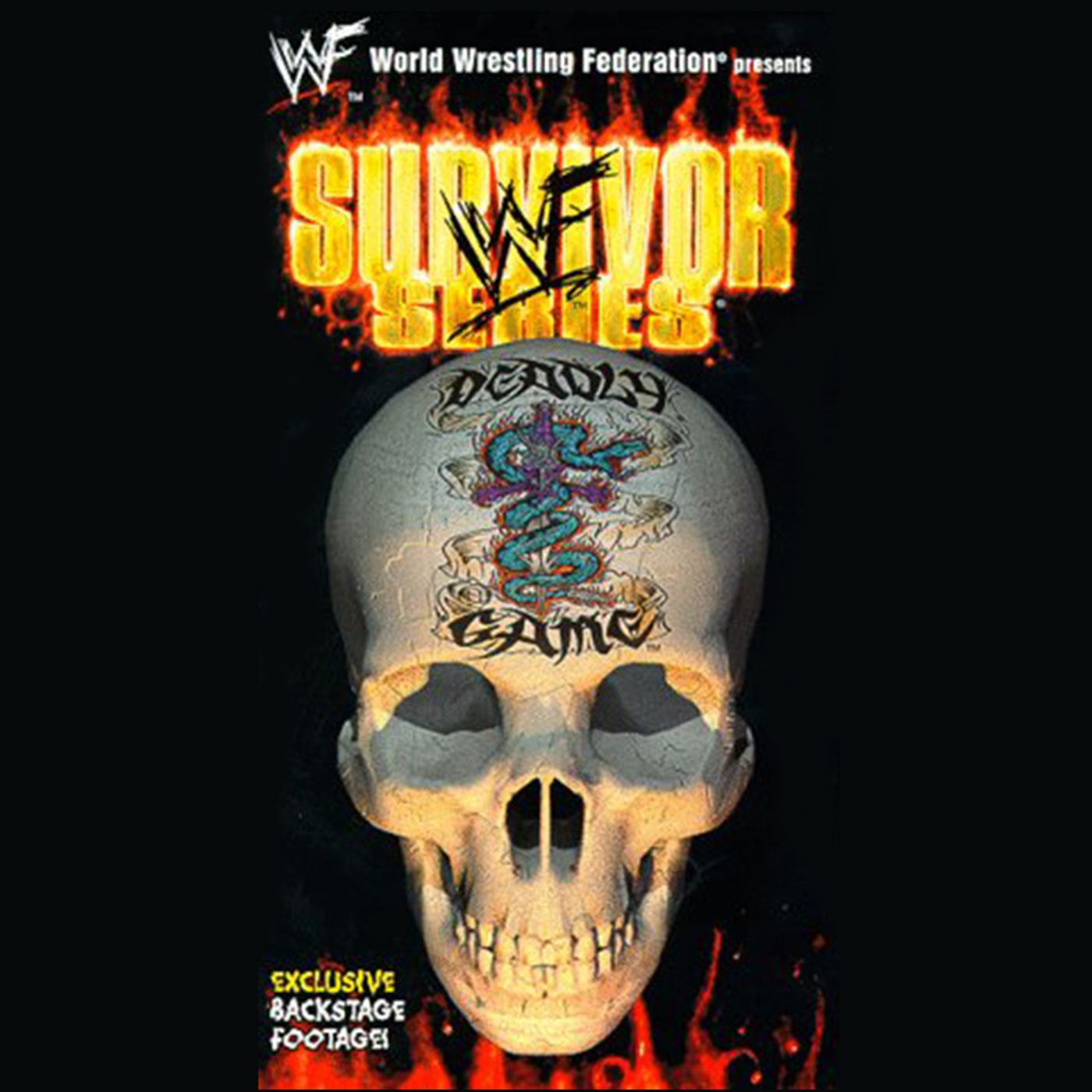
Ep. 51: 1998 WWE Survivor Series
Your deep dive into the 1998 WWF Survivor Series “Deadly Game” scrutinizes all angles of the WWF title tournament that sharply turned The Rock heel just as he was beginning to catch babyface fire, and the lessons that can be applied to a certain Roman Reigns.
Immerse yourself in attitudinal booking with a study on the elements that helped the WWF, by this point in 1998, decisively pull ahead in the Monday night ratings wars, and never look back.
The show includes:
- SO MANY signs in the crowd. Just a sea of neon cardboard.
- The Rock breaks through a bonafide top guy
- Vince makes each and every bout of manipulation sing from his wheelchair in a vintage performance
- The confounding first WWF run of William Regal as the “Real Man’s Man”
- The Big Bossman invades every nook and cranny of the show, except the run-in he was supposed to do in Austin v. Mankind, killing the match’s heat
- The name of the football squad Duane Gill coached to glory
- JR on X-Pac’s “suddenness”
- Ken Shamrock huracanranas
- The crowd is asked to react to an Undertaker who just admitted he set the fire that destroyed his family and was blamed on Kane
- JR actually says this: “Mankind has opened up offensively now after realizing that the tube sock was around the mannequin head.” #AttitudeEra
All that and so much more, as TLF dissects the qualities that make the 1998 Survivor Series a true harbinger for a WWF product re-imagining that sent the company to new heights (and occasionally new lows).
Available Results
Generated results are saved to your library for reuse and search.
Choose Template
Pick the result you want. You can review provider and model before generating.
A concise first-pass summary for understanding the episode quickly.
A comprehensive, source-grounded extraction of the reusable knowledge in an episode.
A comprehensive extraction focused on opportunities, strategy, markets, and company building.
Explicit actions, next steps, habits, recommendations, and things to avoid.
Repeatable methods, frameworks, mental models, processes, and systems.
A dedicated inventory of concrete resources named in the episode.
A concise first-pass summary for understanding the episode quickly.
A detailed readable summary organized by chapter or topic.
A navigable map of subjects, topic flow, and suggested chapters.
A comprehensive, source-grounded extraction of the reusable knowledge in an episode.
Reusable atomic knowledge units extracted from the episode.
A comprehensive extraction focused on health practices, protocols, claims, and safety caveats.
A comprehensive extraction focused on opportunities, strategy, markets, and company building.
Explicit actions, next steps, habits, recommendations, and things to avoid.
A dedicated inventory of concrete resources named in the episode.
A dedicated analysis of warnings, limitations, trade-offs, weak evidence, and uncertainty.
A concise first-pass summary for understanding the episode quickly.
A detailed readable summary organized by chapter or topic.
A navigable map of subjects, topic flow, and suggested chapters.
A comprehensive, source-grounded extraction of the reusable knowledge in an episode.
Reusable atomic knowledge units extracted from the episode.
A comprehensive extraction focused on health practices, protocols, claims, and safety caveats.
A comprehensive extraction focused on opportunities, strategy, markets, and company building.
Scientific findings, mechanisms, studies, hypotheses, and the limits of the evidence discussed.
Technologies, AI models, technical methods, capabilities, limitations, and adoption implications.
Investment theses, assets, catalysts, valuation reasoning, time horizons, and risks.
Chronologies, actors, causes, consequences, turning points, and competing historical interpretations.
Policies, proposals, stakeholders, arguments, implementation constraints, and predicted effects.
Career paths, skills, hiring signals, workplace decisions, transitions, and limitations of the advice.
Behavioral mechanisms, biases, motivation, habits, emotions, interventions, and evidence limitations.
Economic mechanisms, incentives, indicators, market structure, forecasts, and uncertainty.
Leadership principles, team systems, organizational design, culture, feedback, and failure modes.
Audience, positioning, messaging, acquisition, retention, experiments, metrics, and failed approaches.
Teaching methods, learning strategies, practice, feedback, assessment, and effectiveness evidence.
Theses, premises, arguments, objections, values, thought experiments, and unresolved questions.
Communication patterns, conflict, boundaries, expectations, repair methods, and contextual limitations.
Books, papers, authors, courses, and other learning resources mentioned in the episode.
Repeatable methods, frameworks, mental models, processes, and systems.
Explicit actions, next steps, habits, recommendations, and things to avoid.
Memorable statements and important claims with attribution and source context.
A dedicated inventory of concrete resources named in the episode.
A dedicated analysis of warnings, limitations, trade-offs, weak evidence, and uncertainty.