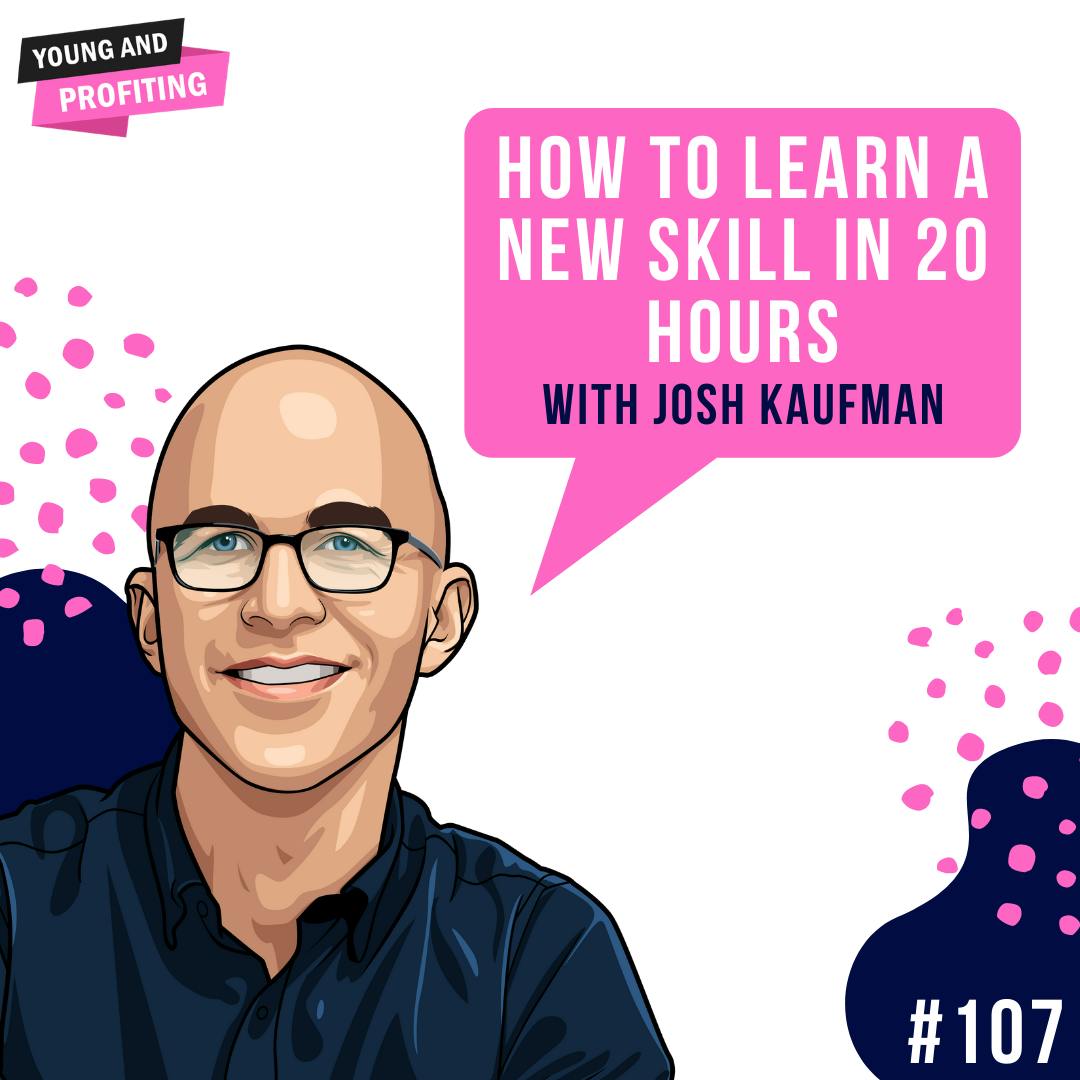
Josh Kaufman: How to Learn a New Skill in 20 Hours | E107
Want to start a business but not sure where (or how) to start?!
In today’s episode, we are talking with Josh Kaufman, best-selling author, researcher, and speaker. Josh's TEDx talk on The First 20 Hours is one of the top 25 most-viewed TED talks published to date, with over 22 million views on YouTube. His research has been featured by The New York Times, The BBC, The Wall Street Journal, The Atlantic, Fortune, Forbes, Time, BusinessWeek, Wired, Fast Company, Financial Times, HarvardBusiness.org, The World Economic Forum, Inside Higher Ed, Lifehacker, MarketWatch, The Independent, Bloomberg TV, PBS Next Avenue, CCTV, and CNN's Sanjay Gupta MD.
In this episode, we chat about Josh’s first book, Personal MBA, signs to find a viable market if you are starting a business, and the characteristics that all good products/services have. We’ll also talk more about how to test out your business idea, actionable steps to decide pricing, learning curves, the aspects of rapid skills acquisition, and more. This is a jam packed episode that we made it into two parts - so make sure to catch both!
Social Media:
Follow YAP on IG: www.instagram.com/youngandprofiting
Reach out to Hala directly at Hala@YoungandProfiting.com
Follow Hala on Linkedin: www.linkedin.com/in/htaha/
Follow Hala on Instagram: www.instagram.com/yapwithhala
Follow Hala on ClubHouse: @halataha
Check out our website to meet the team, view show notes and transcripts: www.youngandprofiting.com
Timestamps:
03:29 - Perfecting Skills in 20 Hours
10:04 - Emotions Behind Starting Something New
13:46 - What a Learning Curve Looks Like
21:31 - 4 Steps of Rapid Skill Acquisition
29:40 - How Josh’s TED Talk Changed His Life
34:39 - Premise of Josh’s New Book, How to Fight a Hydra
39:58 - Josh’s Secret to Profiting in Life
Mentioned in the Episode:
Josh’s Website: joshkaufman.net
Josh’s First Book, Personal MBA: https://personalmba.com/
Josh’s Second Book, The First 20 Hours: https://first20hours.com/
Josh’s New Book, How to Fight a Hydra: https://howtofightahydra.com/#home
Available Results
Generated results are saved to your library for reuse and search.
Choose Template
Pick the result you want. You can review provider and model before generating.
A concise first-pass summary for understanding the episode quickly.
A comprehensive, source-grounded extraction of the reusable knowledge in an episode.
A comprehensive extraction focused on opportunities, strategy, markets, and company building.
Explicit actions, next steps, habits, recommendations, and things to avoid.
Repeatable methods, frameworks, mental models, processes, and systems.
A dedicated inventory of concrete resources named in the episode.
A concise first-pass summary for understanding the episode quickly.
A detailed readable summary organized by chapter or topic.
A navigable map of subjects, topic flow, and suggested chapters.
A comprehensive, source-grounded extraction of the reusable knowledge in an episode.
Reusable atomic knowledge units extracted from the episode.
A comprehensive extraction focused on health practices, protocols, claims, and safety caveats.
A comprehensive extraction focused on opportunities, strategy, markets, and company building.
Explicit actions, next steps, habits, recommendations, and things to avoid.
A dedicated inventory of concrete resources named in the episode.
A dedicated analysis of warnings, limitations, trade-offs, weak evidence, and uncertainty.
A concise first-pass summary for understanding the episode quickly.
A detailed readable summary organized by chapter or topic.
A navigable map of subjects, topic flow, and suggested chapters.
A comprehensive, source-grounded extraction of the reusable knowledge in an episode.
Reusable atomic knowledge units extracted from the episode.
A comprehensive extraction focused on health practices, protocols, claims, and safety caveats.
A comprehensive extraction focused on opportunities, strategy, markets, and company building.
Scientific findings, mechanisms, studies, hypotheses, and the limits of the evidence discussed.
Technologies, AI models, technical methods, capabilities, limitations, and adoption implications.
Investment theses, assets, catalysts, valuation reasoning, time horizons, and risks.
Chronologies, actors, causes, consequences, turning points, and competing historical interpretations.
Policies, proposals, stakeholders, arguments, implementation constraints, and predicted effects.
Career paths, skills, hiring signals, workplace decisions, transitions, and limitations of the advice.
Behavioral mechanisms, biases, motivation, habits, emotions, interventions, and evidence limitations.
Economic mechanisms, incentives, indicators, market structure, forecasts, and uncertainty.
Leadership principles, team systems, organizational design, culture, feedback, and failure modes.
Audience, positioning, messaging, acquisition, retention, experiments, metrics, and failed approaches.
Teaching methods, learning strategies, practice, feedback, assessment, and effectiveness evidence.
Theses, premises, arguments, objections, values, thought experiments, and unresolved questions.
Communication patterns, conflict, boundaries, expectations, repair methods, and contextual limitations.
Books, papers, authors, courses, and other learning resources mentioned in the episode.
Repeatable methods, frameworks, mental models, processes, and systems.
Explicit actions, next steps, habits, recommendations, and things to avoid.
Memorable statements and important claims with attribution and source context.
A dedicated inventory of concrete resources named in the episode.
A dedicated analysis of warnings, limitations, trade-offs, weak evidence, and uncertainty.