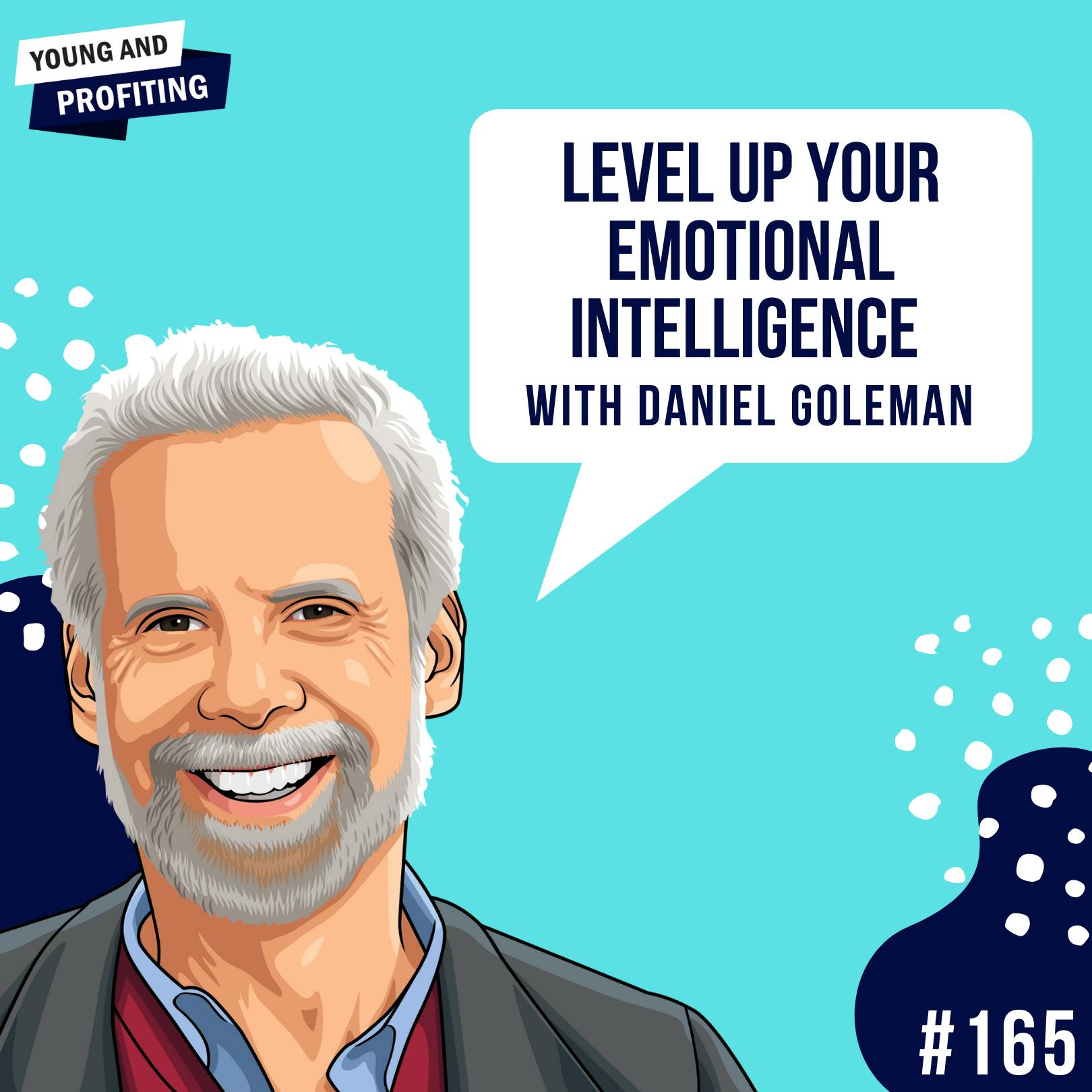
Daniel Goleman: Level Up Your Emotional Intelligence | E165
How do you react to challenging situations and interactions? Are you able to express empathy and understanding even when you’re feeling frustrated and unheard? If so, you might have high emotional intelligence (EQ). A high EQ is one of the most important skill sets you can have if you want to thrive in and outside of the office. People with high EQ are more likely to be effective communicators, problem-solvers, and more. If you think you have a low EQ and tend to react based on your emotions, don’t worry! Best-selling author and psychologist Dan Goleman knows that these skills can be learned! We can all harness our emotions and use them for our benefit. In this episode, Hala talks to Dan about IQ VS EQ, the link between mindfulness and EQ, the four aspects of an emotionally intelligent person, parasympathetic and sympathetic modes, the relationship between anxiety and performance, and gives actionable tips about how we can learn emotional intelligence.
Topics Include:
- Dan’s Journey
- The basis of his book Emotional Intelligence
- IQ VS EQ
- Learning EQ and neuroplasticity
- Link between meditation and stress reactivity
- Four parts of an emotionally intelligent person
- Value of emotions
- Emotional Stoplight
- Cyber disinhibition
- Types of brains and brain biology
- Amygdala hijacks
- Steps to developing emotional intelligence
- Inner dialogue and how to speak to ourselves
- Parasympathetic vs sympathetic mode
- Relationship between anxiety and performance
- Self-motivation and purpose
- “The Good Cry” and why this phenomenon may not hold weight
- Recipe for getting over an argument
- How to shift your mood
- Three different types of empathy and how you use them
- How emotional intelligence impacts society
- How EQ translates into organizational performance
- Dan’s actionable advice to be more profitable tomorrow
- Dan's secret to profiting in life
- And other topics…
Daniel Goleman is the author of the best-selling book Emotional Intelligence, as well as many other works in emotional and social intelligence, leadership, and education. He is also a psychologist, former science journalist for the New York Times, and co-director of the Consortium for Research on Emotional Intelligence in Organizations.
Daniel co-founded the Collaborative for Academic, Social, and Emotional Learning at Yale University’s Child Studies Center. He lectures frequently to professional audiences, and is the host of the First Person Plural podcast.
He holds a bachelor’s degree from Amherst College, and a PhD in clinical psychology and personality development from Harvard, where he also taught.
Sponsored By:
Peloton - Visit onepeloton.com to learn more.
Indeed - Go to Indeed.com/profiting to claim your $75 credit before April 30th
WRKOUT - Visit wrkout.com/yap to book a FREE Session with a world-class trainer and get 30% off your first TWO MONTHS with code YAP
Jordan Harbinger - Check out jordanharbinger.com/start for some episode recommendations
Constant Contact - To start your free digital marketing trial today, visit constantcontact.com
99designs by Vista - Head to 99designs.com/YAP to learn more and get $30 off your first design contest!
Resources Mentioned:
Dan’s Books: https://www.danielgoleman.info/purchase/
Dan’s EI Assessments: https://www.danielgoleman.info/ei-assessments/
Dan’s Podcast, First Person Plural: https://www.keystepmedia.com/first-person-plural/
Dan’s LinkedIn: https://www.linkedin.com/in/danielgoleman/
Dan’s Facebook: https://www.facebook.com/danielgoleman
Dan’s Instagram: https://www.instagram.com/daniel_goleman_/
Connect with Young and Profiting:
YAP’s Instagram: https://www.instagram.com/youngandprofiting/
Hala’s Linkedin: https://www.linkedin.com/in/htaha/
Hala’s Instagram:https://www.instagram.com/yapwithhala/
Clubhouse: https://www.clubhouse.com/@halataha
Website: https://www.youngandprofiting.com/
Text Me via @SlickText: https://youngandprofiting.co/TextHala
Available Results
Generated results are saved to your library for reuse and search.
Choose Template
Pick the result you want. You can review provider and model before generating.
A concise first-pass summary for understanding the episode quickly.
A comprehensive, source-grounded extraction of the reusable knowledge in an episode.
Scientific findings, mechanisms, studies, hypotheses, and the limits of the evidence discussed.
A dedicated analysis of warnings, limitations, trade-offs, weak evidence, and uncertainty.
Memorable statements and important claims with attribution and source context.
Technologies, AI models, technical methods, capabilities, limitations, and adoption implications.
A concise first-pass summary for understanding the episode quickly.
A detailed readable summary organized by chapter or topic.
A navigable map of subjects, topic flow, and suggested chapters.
A comprehensive, source-grounded extraction of the reusable knowledge in an episode.
Reusable atomic knowledge units extracted from the episode.
A comprehensive extraction focused on health practices, protocols, claims, and safety caveats.
A comprehensive extraction focused on opportunities, strategy, markets, and company building.
Explicit actions, next steps, habits, recommendations, and things to avoid.
A dedicated inventory of concrete resources named in the episode.
A dedicated analysis of warnings, limitations, trade-offs, weak evidence, and uncertainty.
A concise first-pass summary for understanding the episode quickly.
A detailed readable summary organized by chapter or topic.
A navigable map of subjects, topic flow, and suggested chapters.
A comprehensive, source-grounded extraction of the reusable knowledge in an episode.
Reusable atomic knowledge units extracted from the episode.
A comprehensive extraction focused on health practices, protocols, claims, and safety caveats.
A comprehensive extraction focused on opportunities, strategy, markets, and company building.
Scientific findings, mechanisms, studies, hypotheses, and the limits of the evidence discussed.
Technologies, AI models, technical methods, capabilities, limitations, and adoption implications.
Investment theses, assets, catalysts, valuation reasoning, time horizons, and risks.
Chronologies, actors, causes, consequences, turning points, and competing historical interpretations.
Policies, proposals, stakeholders, arguments, implementation constraints, and predicted effects.
Career paths, skills, hiring signals, workplace decisions, transitions, and limitations of the advice.
Behavioral mechanisms, biases, motivation, habits, emotions, interventions, and evidence limitations.
Economic mechanisms, incentives, indicators, market structure, forecasts, and uncertainty.
Leadership principles, team systems, organizational design, culture, feedback, and failure modes.
Audience, positioning, messaging, acquisition, retention, experiments, metrics, and failed approaches.
Teaching methods, learning strategies, practice, feedback, assessment, and effectiveness evidence.
Theses, premises, arguments, objections, values, thought experiments, and unresolved questions.
Communication patterns, conflict, boundaries, expectations, repair methods, and contextual limitations.
Books, papers, authors, courses, and other learning resources mentioned in the episode.
Repeatable methods, frameworks, mental models, processes, and systems.
Explicit actions, next steps, habits, recommendations, and things to avoid.
Memorable statements and important claims with attribution and source context.
A dedicated inventory of concrete resources named in the episode.
A dedicated analysis of warnings, limitations, trade-offs, weak evidence, and uncertainty.