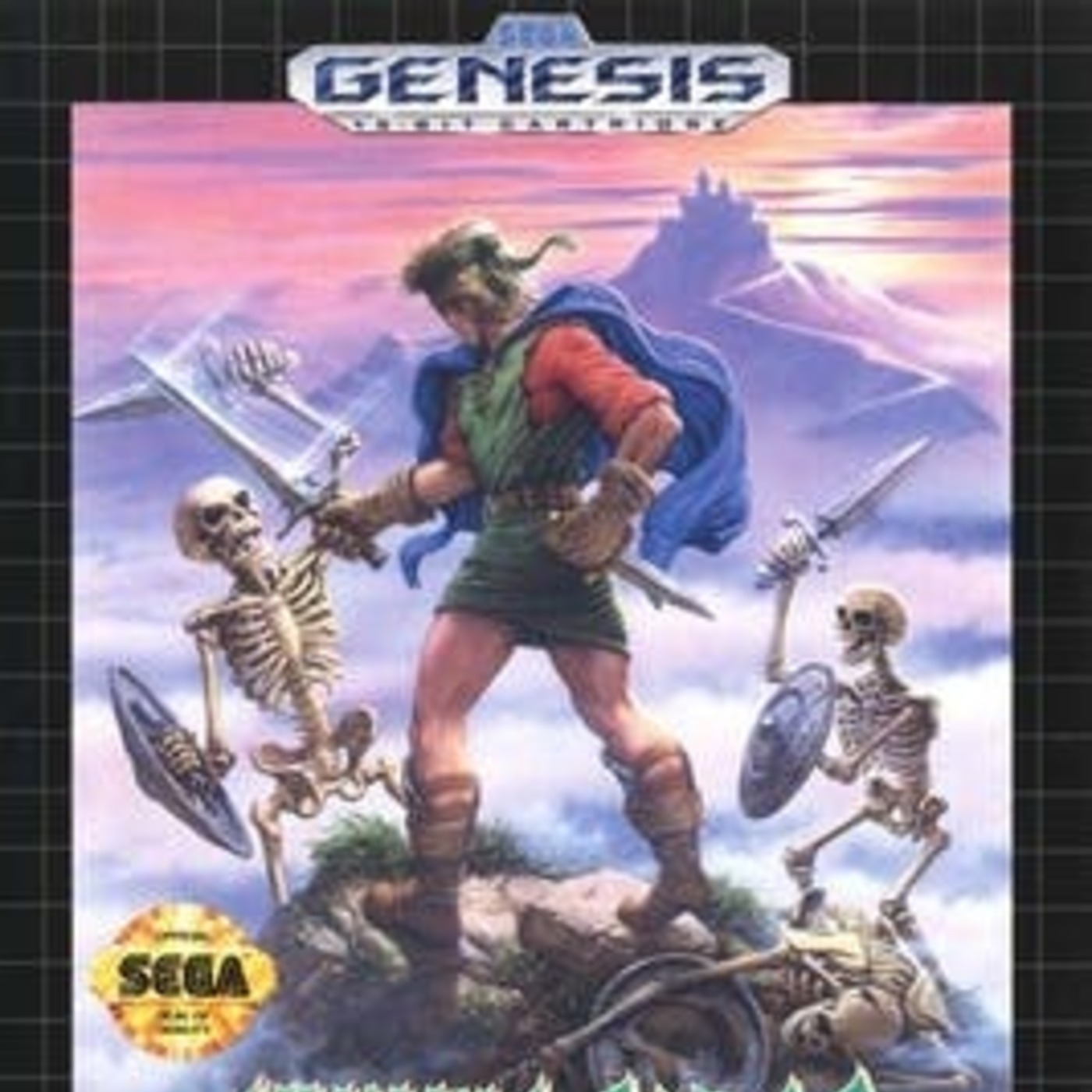
Remember The Game? #51 - Shining Force
One of my favourite things about doing this podcast is that I'm discovering new retro games all these years later. Particularly when it comes to Sega. You're going to see more Genesis love in year 2 of this show, and it starts with today's game; Shining Force.
**On that note, if you haven't played a game that's covered on the show, I encourage you to give the episode a listen, anyways. Maybe it'll peak your interest and help you discover a new game to play as well! (And please let me know if that ends up being the case!)** Shining Force is rad. I just recently played through it on my friend Miklos's suggestion, and I loved it. It's a great tactical RPG (imagine an RPG board game). You and the computer move your characters around on a grid style map, taking turns attacking each other. Most maps have various landscapes throughout their tiles, and they can provide offensive and defensive strategies. It's like playing RPG chess in a way. And Shining Force is one of the grandfather's of the genre. I think I described it as the Dragon Warrior of tactical RPGs. For better and for worse. While the gameplay itself is fun, and it contains many of the elements that have caused me to completely fall in love with the tactical genre (strategy, levelling up characters, and a stiff challenge) it has a lot of faults, too. Clearly, this was a learning process for the developers, and some of the mechanics are ancient and frustrating to work through. Menu navigation is a nightmare. So is inventory management. It's just clunky and boring. Luckily, that makes up just a small portion of your experience with Shining Force. I found myself gritting my teeth and slogging through the standard "village between battles restock" that comes with most RPGS, because I knew another fun battle map was waiting on the other side.
Tactical RPGs have become one of my favourite styles of video game, and it was really cool playing what some consider the Super Mario Bros of the genre. It has it's warts, but nothing that ruins the experience. My buddy Miklos came through with a killer recommendation by suggesting I give Shining Force a shot, and he joins me on the show this week to talk about why it's so awesome. Enjoy!
Learn more about your ad choices. Visit megaphone.fm/adchoices
See Privacy Policy at https://art19.com/privacy and California Privacy Notice at https://art19.com/privacy#do-not-sell-my-info.
Available Results
Generated results are saved to your library for reuse and search.
Choose Template
Pick the result you want. You can review provider and model before generating.
A concise first-pass summary for understanding the episode quickly.
A comprehensive, source-grounded extraction of the reusable knowledge in an episode.
A comprehensive extraction focused on opportunities, strategy, markets, and company building.
Explicit actions, next steps, habits, recommendations, and things to avoid.
Repeatable methods, frameworks, mental models, processes, and systems.
A dedicated inventory of concrete resources named in the episode.
A concise first-pass summary for understanding the episode quickly.
A detailed readable summary organized by chapter or topic.
A navigable map of subjects, topic flow, and suggested chapters.
A comprehensive, source-grounded extraction of the reusable knowledge in an episode.
Reusable atomic knowledge units extracted from the episode.
A comprehensive extraction focused on health practices, protocols, claims, and safety caveats.
A comprehensive extraction focused on opportunities, strategy, markets, and company building.
Explicit actions, next steps, habits, recommendations, and things to avoid.
A dedicated inventory of concrete resources named in the episode.
A dedicated analysis of warnings, limitations, trade-offs, weak evidence, and uncertainty.
A concise first-pass summary for understanding the episode quickly.
A detailed readable summary organized by chapter or topic.
A navigable map of subjects, topic flow, and suggested chapters.
A comprehensive, source-grounded extraction of the reusable knowledge in an episode.
Reusable atomic knowledge units extracted from the episode.
A comprehensive extraction focused on health practices, protocols, claims, and safety caveats.
A comprehensive extraction focused on opportunities, strategy, markets, and company building.
Scientific findings, mechanisms, studies, hypotheses, and the limits of the evidence discussed.
Technologies, AI models, technical methods, capabilities, limitations, and adoption implications.
Investment theses, assets, catalysts, valuation reasoning, time horizons, and risks.
Chronologies, actors, causes, consequences, turning points, and competing historical interpretations.
Policies, proposals, stakeholders, arguments, implementation constraints, and predicted effects.
Career paths, skills, hiring signals, workplace decisions, transitions, and limitations of the advice.
Behavioral mechanisms, biases, motivation, habits, emotions, interventions, and evidence limitations.
Economic mechanisms, incentives, indicators, market structure, forecasts, and uncertainty.
Leadership principles, team systems, organizational design, culture, feedback, and failure modes.
Audience, positioning, messaging, acquisition, retention, experiments, metrics, and failed approaches.
Teaching methods, learning strategies, practice, feedback, assessment, and effectiveness evidence.
Theses, premises, arguments, objections, values, thought experiments, and unresolved questions.
Communication patterns, conflict, boundaries, expectations, repair methods, and contextual limitations.
Books, papers, authors, courses, and other learning resources mentioned in the episode.
Repeatable methods, frameworks, mental models, processes, and systems.
Explicit actions, next steps, habits, recommendations, and things to avoid.
Memorable statements and important claims with attribution and source context.
A dedicated inventory of concrete resources named in the episode.
A dedicated analysis of warnings, limitations, trade-offs, weak evidence, and uncertainty.