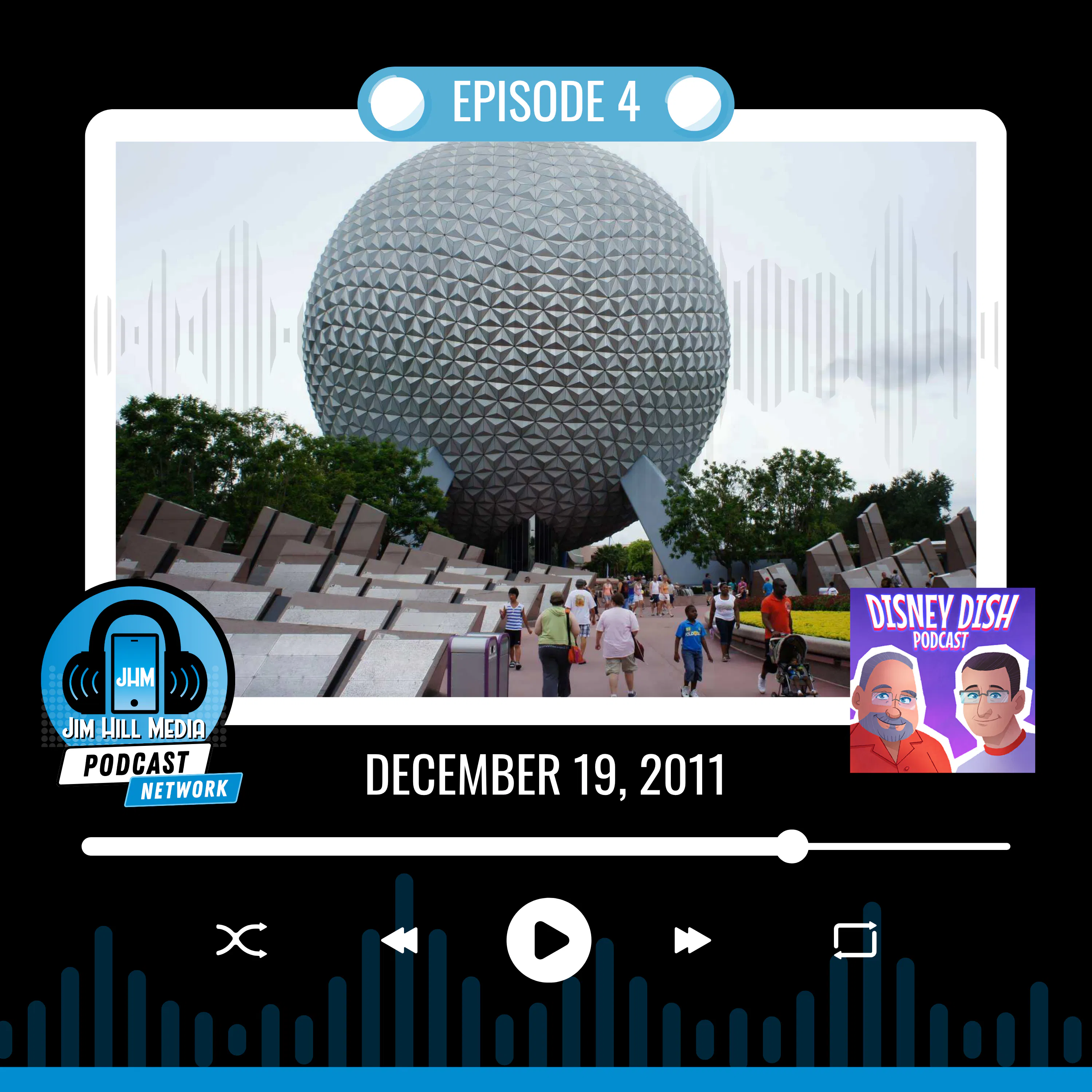
Epcot’s Future World in 2011: Lost Concepts and Disney What-Ifs (Ep. 4)
Len Testa and Jim Hill take listeners on a real-time stroll through Epcot during the 2011 Food & Wine Festival, offering an on-the-ground snapshot of Future World before many of its biggest changes. Along the way, they discuss everything from the controversial Leave A Legacy monoliths and the challenges of corporate sponsorships to lost attraction concepts, abandoned pavilion ideas, and the evolving identity of Epcot itself. The episode captures a fascinating moment in Disney Parks history, with candid commentary about attractions like Journey Into Imagination, The Seas with Nemo & Friends, Mission: SPACE, and Universe of Energy just years before major overhauls began reshaping the park. It’s part park tour, part Imagineering history lesson, and part time capsule from a very different era of Walt Disney World.
Original Air Date: December 19, 2011
Original Title: A Live Walk Through Epcot
HIGHLIGHTS
- Jim and Len debate the infamous Leave A Legacy monoliths and why Disney quickly realized the project wasn’t working visually.
- Stories from Epcot’s early sponsorship struggles, including how difficult it was to convince major corporations to back Future World pavilions.
- Behind-the-scenes discussion of abandoned concepts for The Living Seas, including a massive Poseidon animatronic and underwater ride-through experience.
- The duo explores Innoventions and discusses why keeping Future World exhibits fresh became such a financial challenge for sponsors.
- Details about Project Gemini, including canceled plans for rainforest coasters, Time Racers inside Spaceship Earth, and major pavilion overhauls.
- Jim shares stories about Dreamfinder, Figment, Kodak’s ownership stake in the characters, and failed celebrity-driven Journey Into Imagination concepts.
- Conversations about early rumors surrounding Finding Nemo sequels and Ellen DeGeneres potentially helping refresh Universe of Energy.
- Discussion of Mission: SPACE’s original concept, the evolution of Test Track technology, and how Disney hoped certain ride systems would spread worldwide.
- A pavilion-by-pavilion walking tour through Future World circa 2011, capturing attractions, exhibits, and design philosophies that no longer exist today.
- Jim shares Imagineering stories about Epcot’s original sponsorship model and how Walt Disney’s absence fundamentally changed corporate negotiations.
- Detailed observations about the state of Innoventions, ImageWorks, Living with the Land, and other attractions during a transitional era for the park.
- A fascinating historical snapshot of Epcot before the massive redevelopment projects that would eventually transform Future World into World Celebration, World Nature, and World Discovery.
HOSTS
• Jim Hill - IG: @JimHillMedia | X: @JimHillMedia | Website: JimHillMedia.com • Len Testa - Bluesky: @lentesta.bsky.social | Instagram: @len.testa | Website: touringplans.com
FOLLOW
• Facebook: JimHillMediaNews • Instagram: JimHillMedia • TikTok: JimHillMedia
SUPPORT
Support the show and access bonus episodes and additional content at Patreon.com/JimHillMedia.
If you would like to sponsor a show on the Jim Hill Media Podcast Network, reach out today.
Learn more about your ad choices. Visit megaphone.fm/adchoices
Available Results
Generated results are saved to your library for reuse and search.
Choose Template
Pick the result you want. You can review provider and model before generating.
A concise first-pass summary for understanding the episode quickly.
A comprehensive, source-grounded extraction of the reusable knowledge in an episode.
Technologies, AI models, technical methods, capabilities, limitations, and adoption implications.
Repeatable methods, frameworks, mental models, processes, and systems.
A dedicated analysis of warnings, limitations, trade-offs, weak evidence, and uncertainty.
A dedicated inventory of concrete resources named in the episode.
A concise first-pass summary for understanding the episode quickly.
A detailed readable summary organized by chapter or topic.
A navigable map of subjects, topic flow, and suggested chapters.
A comprehensive, source-grounded extraction of the reusable knowledge in an episode.
Reusable atomic knowledge units extracted from the episode.
A comprehensive extraction focused on health practices, protocols, claims, and safety caveats.
A comprehensive extraction focused on opportunities, strategy, markets, and company building.
Explicit actions, next steps, habits, recommendations, and things to avoid.
A dedicated inventory of concrete resources named in the episode.
A dedicated analysis of warnings, limitations, trade-offs, weak evidence, and uncertainty.
A concise first-pass summary for understanding the episode quickly.
A detailed readable summary organized by chapter or topic.
A navigable map of subjects, topic flow, and suggested chapters.
A comprehensive, source-grounded extraction of the reusable knowledge in an episode.
Reusable atomic knowledge units extracted from the episode.
A comprehensive extraction focused on health practices, protocols, claims, and safety caveats.
A comprehensive extraction focused on opportunities, strategy, markets, and company building.
Scientific findings, mechanisms, studies, hypotheses, and the limits of the evidence discussed.
Technologies, AI models, technical methods, capabilities, limitations, and adoption implications.
Investment theses, assets, catalysts, valuation reasoning, time horizons, and risks.
Chronologies, actors, causes, consequences, turning points, and competing historical interpretations.
Policies, proposals, stakeholders, arguments, implementation constraints, and predicted effects.
Career paths, skills, hiring signals, workplace decisions, transitions, and limitations of the advice.
Behavioral mechanisms, biases, motivation, habits, emotions, interventions, and evidence limitations.
Economic mechanisms, incentives, indicators, market structure, forecasts, and uncertainty.
Leadership principles, team systems, organizational design, culture, feedback, and failure modes.
Audience, positioning, messaging, acquisition, retention, experiments, metrics, and failed approaches.
Teaching methods, learning strategies, practice, feedback, assessment, and effectiveness evidence.
Theses, premises, arguments, objections, values, thought experiments, and unresolved questions.
Communication patterns, conflict, boundaries, expectations, repair methods, and contextual limitations.
Books, papers, authors, courses, and other learning resources mentioned in the episode.
Repeatable methods, frameworks, mental models, processes, and systems.
Explicit actions, next steps, habits, recommendations, and things to avoid.
Memorable statements and important claims with attribution and source context.
A dedicated inventory of concrete resources named in the episode.
A dedicated analysis of warnings, limitations, trade-offs, weak evidence, and uncertainty.