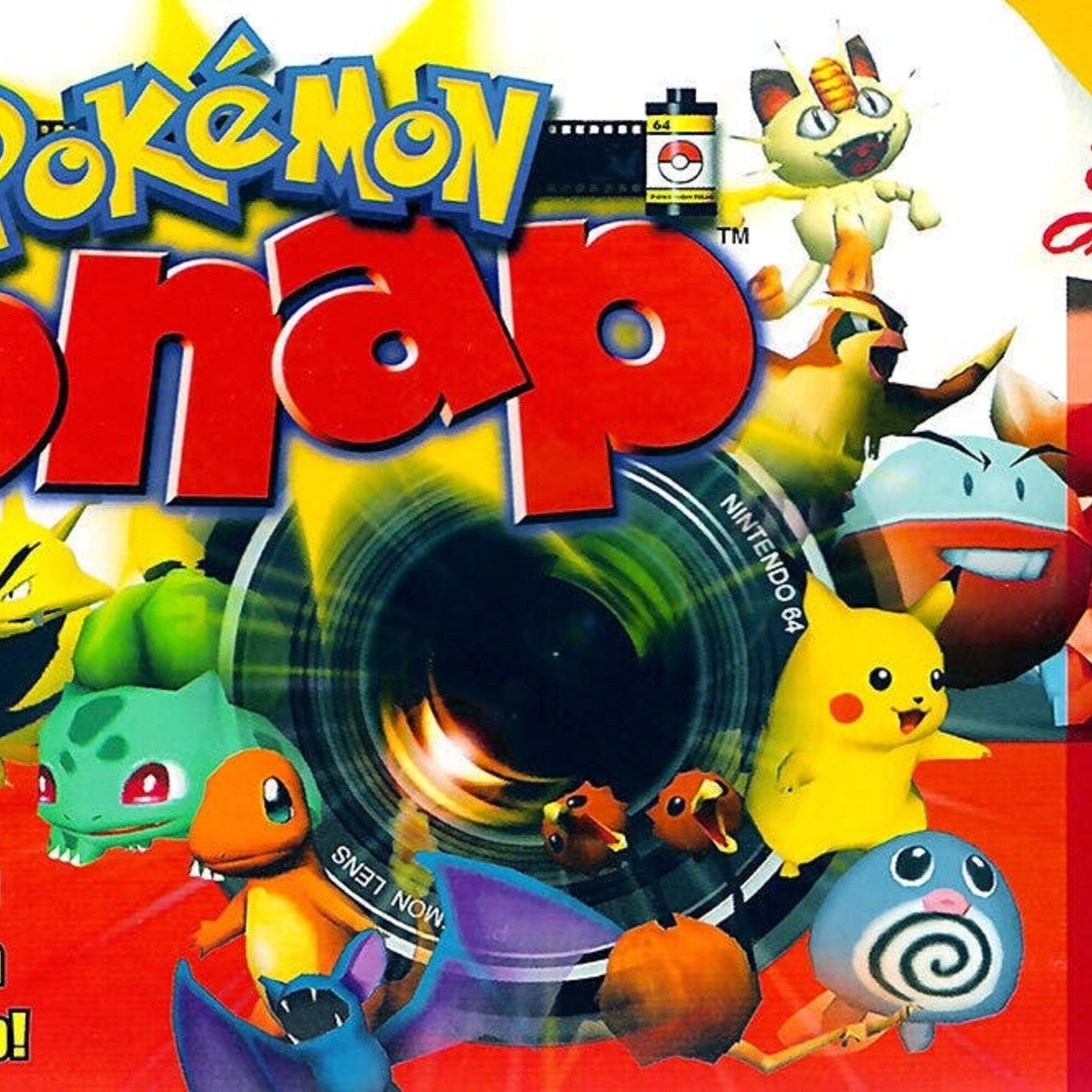
Remember The Game? #61 - Pokemon Snap
The fact that we haven't seen a Pokemon Snap re-release, remake, or sequel on smartphones, the Wii U, or the Switch is almost mind-boggling. And then you remember it's Nintendo... We all played this, right?? I remember this being one of the few games I could play with my brother and not fight (much). Pokemon Snap. You're on rails, and you can't die. You just take photos of Pokemon. Might sound silly in 2019, but holy hell this game was a big deal twenty years ago. Outside of the cartoon, we hadn't really seen much of Pokemon outside of their pixelated Game Boy iterations. Getting to see all of our favourites (and that loser Charmander) out in the wild was pretty damned cool. Being able to throw apples at them to make them happy or angry was even cooler. And flipping through your roll of film to find your best photos and using them to impress a weird old man? The coolest. That's all Pokemon Snap was. Try to get Pokemon to react to something you did, so you could snap killer photos of them. The better your photo, the better the score. That's it. No fighting. no bosses, no real drama or story. It didn't need it, though. There was something so addictive about constantly trying to get a better shot. You could play levels over and over looking for secret paths or different ways to cause the pokemon to do things you could get new photos of. And obviously, the biggest hook (for me anyways), was constantly exploring in hopes of finding a new pokemon. I don't think all original 151 were in here (which is very weird), but enough were there to justify running the levels or and over again. This was, in 1999, the closest we'd seen to Pokemon in real life. This game SCREAMS for a sequel or remake with today's technology. Being able to spin around with your Switch, take photos, and then post your best ones online would be fucking awesome. Because admit it, when you got a killer shot of a Charizard looking all pissed off, you wanted to show it to everybody. Anybody. Someone other than that stupid old man Oak... This wasn't the deepest game in the world, but it didn't matter. It was huge. We all loved it (whether we admitted it or not), and my buddy Andre and I had a hell of a time looking back at it. Give us a God damned sequel, Nintendo!!!
Learn more about your ad choices. Visit megaphone.fm/adchoices
See Privacy Policy at https://art19.com/privacy and California Privacy Notice at https://art19.com/privacy#do-not-sell-my-info.
Available Results
Generated results are saved to your library for reuse and search.
Choose Template
Pick the result you want. You can review provider and model before generating.
A concise first-pass summary for understanding the episode quickly.
A comprehensive, source-grounded extraction of the reusable knowledge in an episode.
Technologies, AI models, technical methods, capabilities, limitations, and adoption implications.
Repeatable methods, frameworks, mental models, processes, and systems.
A dedicated analysis of warnings, limitations, trade-offs, weak evidence, and uncertainty.
A dedicated inventory of concrete resources named in the episode.
A concise first-pass summary for understanding the episode quickly.
A detailed readable summary organized by chapter or topic.
A navigable map of subjects, topic flow, and suggested chapters.
A comprehensive, source-grounded extraction of the reusable knowledge in an episode.
Reusable atomic knowledge units extracted from the episode.
A comprehensive extraction focused on health practices, protocols, claims, and safety caveats.
A comprehensive extraction focused on opportunities, strategy, markets, and company building.
Explicit actions, next steps, habits, recommendations, and things to avoid.
A dedicated inventory of concrete resources named in the episode.
A dedicated analysis of warnings, limitations, trade-offs, weak evidence, and uncertainty.
A concise first-pass summary for understanding the episode quickly.
A detailed readable summary organized by chapter or topic.
A navigable map of subjects, topic flow, and suggested chapters.
A comprehensive, source-grounded extraction of the reusable knowledge in an episode.
Reusable atomic knowledge units extracted from the episode.
A comprehensive extraction focused on health practices, protocols, claims, and safety caveats.
A comprehensive extraction focused on opportunities, strategy, markets, and company building.
Scientific findings, mechanisms, studies, hypotheses, and the limits of the evidence discussed.
Technologies, AI models, technical methods, capabilities, limitations, and adoption implications.
Investment theses, assets, catalysts, valuation reasoning, time horizons, and risks.
Chronologies, actors, causes, consequences, turning points, and competing historical interpretations.
Policies, proposals, stakeholders, arguments, implementation constraints, and predicted effects.
Career paths, skills, hiring signals, workplace decisions, transitions, and limitations of the advice.
Behavioral mechanisms, biases, motivation, habits, emotions, interventions, and evidence limitations.
Economic mechanisms, incentives, indicators, market structure, forecasts, and uncertainty.
Leadership principles, team systems, organizational design, culture, feedback, and failure modes.
Audience, positioning, messaging, acquisition, retention, experiments, metrics, and failed approaches.
Teaching methods, learning strategies, practice, feedback, assessment, and effectiveness evidence.
Theses, premises, arguments, objections, values, thought experiments, and unresolved questions.
Communication patterns, conflict, boundaries, expectations, repair methods, and contextual limitations.
Books, papers, authors, courses, and other learning resources mentioned in the episode.
Repeatable methods, frameworks, mental models, processes, and systems.
Explicit actions, next steps, habits, recommendations, and things to avoid.
Memorable statements and important claims with attribution and source context.
A dedicated inventory of concrete resources named in the episode.
A dedicated analysis of warnings, limitations, trade-offs, weak evidence, and uncertainty.