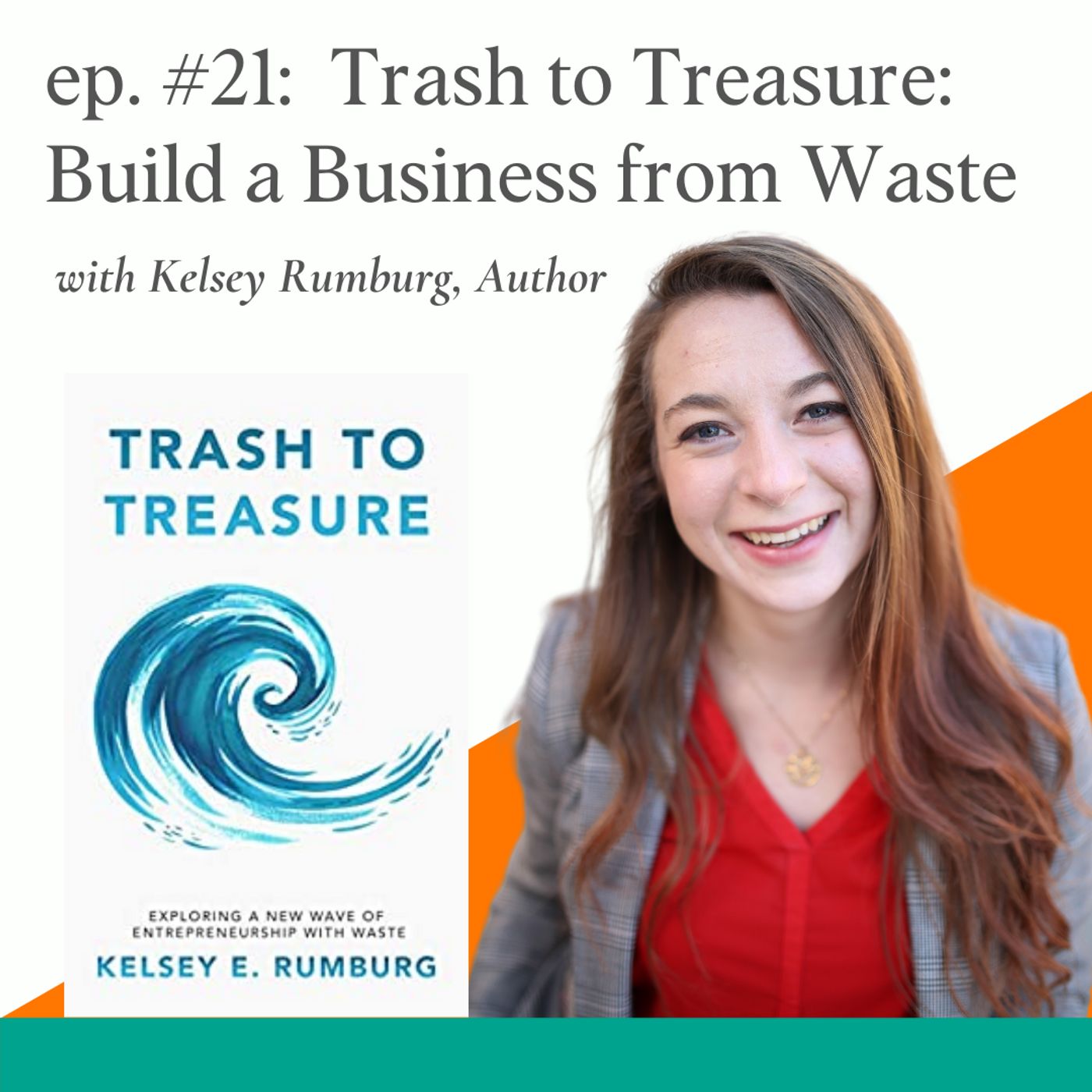
21: Kelsey Rumburg | Trash to Treasure: Build a Business from Waste
Care More Be Better: A Podcast For Sustainable Social Impact and Regeneration
In just 30 years, the world's annual waste output will reach an estimated 3.4 billion tons. This worldwide garbage tsunami endangers our environment, economy, and even our relationships. To survive, we must not only contain it, but also use it.
When we realize that our waste has value, we can start to see how we might put it to greater use in our life. We can change our lives, as well as the businesses and communities around us, by adopting this approach. To reverse the trend, forward-thinking investors and inventors are constructing an economy that views trash as a valuable commodity and an ever-renewable resource. Kelsey’s book, Trash to Treasure: Exploring What It Takes to Build a Business from Waste explores the experiences of modern-day pioneers who are making waves—and money—by turning trash into treasure.
A few businesses you can explore to learn more about reducing waste in your life are Patagonia, Rust Belt Riders and Hungry Harvest. These businesses are as much climate and environmental activists as they are businesses and companies. They are all on a mission to make a sustainable impact, change the world and make it healthier.
About Our Guest, Kelsey Rumburg:
Kelsey conceived a plan to leverage her passion for problem-solving to have a positive influence on the world around her from her family's Midwestern farm. Kelsey is now a part of Miami's startup ecosystem, where she assists entrepreneurs in developing businesses that address environmental, economic, and social challenges.
Time Stamps:
00:00 Introduction
5:02 Where can we start reducing the amount of trash and waste in the world?
6:47 Tips to recycle properly
9:31 What is Terracycle?
12:37 How to build companies that are actually embedding sustainability into reusable products
22:05 What companies are already doing a great job of reducing pollution and waste
30:47 Think regeneratively
32:53 Minimalism
35:39 Living a zero waste lifestyle
39:06 It’s never too late to start reducing your output of waste
JOIN OUR CIRCLE. BUILD A GREENER FUTURE:
🌴 Subscribe to our newsletter, and we'll plant a tree in your honor! https://caremorebebetter.com
🌲 Subscribe and rate us wherever you listen, and we'll plant another tree
Follow us on social media:
YouTube: https://www.youtube.com/@caremorebebetter
TikTok: https://tiktok.com/@caremorebebetter
Instagram: https://www.instagram.com/CareMoreBeBetter/
Facebook: https://www.facebook.com/CareMoreBeBetter
LinkedIn: https://www.linkedin.com/company/caremorebebetter
CONNECT & SUPPORT CARE MORE BE BETTER
Substack: https://caremorebebetter.substack.com
YouTube: https://www.youtube.com/c/caremorebebetter
TikTok: https://www.tiktok.com/@caremorebebetter
Instagram: https://www.instagram.com/caremorebebetter
Facebook: https://www.facebook.com/CareMoreBeBetter
LinkedIn: https://www.linkedin.com/company/care-more-be-better
CAUSE PARTNER: If you value open dialogue, sustainability, and social equity, I invite you to support our new cause partner —Prescott College. To learn more about this effort and to support the show, visit: https://caremorebebetter.com/support/
Hosted by Simplecast, an AdsWizz company. See pcm.adswizz.com for information about our collection and use of personal data for advertising.
Available Results
Generated results are saved to your library for reuse and search.
Choose Template
Pick the result you want. You can review provider and model before generating.
A concise first-pass summary for understanding the episode quickly.
A comprehensive, source-grounded extraction of the reusable knowledge in an episode.
A comprehensive extraction focused on health practices, protocols, claims, and safety caveats.
A dedicated analysis of warnings, limitations, trade-offs, weak evidence, and uncertainty.
Repeatable methods, frameworks, mental models, processes, and systems.
A comprehensive extraction focused on opportunities, strategy, markets, and company building.
A concise first-pass summary for understanding the episode quickly.
A detailed readable summary organized by chapter or topic.
A navigable map of subjects, topic flow, and suggested chapters.
A comprehensive, source-grounded extraction of the reusable knowledge in an episode.
Reusable atomic knowledge units extracted from the episode.
A comprehensive extraction focused on health practices, protocols, claims, and safety caveats.
A comprehensive extraction focused on opportunities, strategy, markets, and company building.
Explicit actions, next steps, habits, recommendations, and things to avoid.
A dedicated inventory of concrete resources named in the episode.
A dedicated analysis of warnings, limitations, trade-offs, weak evidence, and uncertainty.
A concise first-pass summary for understanding the episode quickly.
A detailed readable summary organized by chapter or topic.
A navigable map of subjects, topic flow, and suggested chapters.
A comprehensive, source-grounded extraction of the reusable knowledge in an episode.
Reusable atomic knowledge units extracted from the episode.
A comprehensive extraction focused on health practices, protocols, claims, and safety caveats.
A comprehensive extraction focused on opportunities, strategy, markets, and company building.
Scientific findings, mechanisms, studies, hypotheses, and the limits of the evidence discussed.
Technologies, AI models, technical methods, capabilities, limitations, and adoption implications.
Investment theses, assets, catalysts, valuation reasoning, time horizons, and risks.
Chronologies, actors, causes, consequences, turning points, and competing historical interpretations.
Policies, proposals, stakeholders, arguments, implementation constraints, and predicted effects.
Career paths, skills, hiring signals, workplace decisions, transitions, and limitations of the advice.
Behavioral mechanisms, biases, motivation, habits, emotions, interventions, and evidence limitations.
Economic mechanisms, incentives, indicators, market structure, forecasts, and uncertainty.
Leadership principles, team systems, organizational design, culture, feedback, and failure modes.
Audience, positioning, messaging, acquisition, retention, experiments, metrics, and failed approaches.
Teaching methods, learning strategies, practice, feedback, assessment, and effectiveness evidence.
Theses, premises, arguments, objections, values, thought experiments, and unresolved questions.
Communication patterns, conflict, boundaries, expectations, repair methods, and contextual limitations.
Books, papers, authors, courses, and other learning resources mentioned in the episode.
Repeatable methods, frameworks, mental models, processes, and systems.
Explicit actions, next steps, habits, recommendations, and things to avoid.
Memorable statements and important claims with attribution and source context.
A dedicated inventory of concrete resources named in the episode.
A dedicated analysis of warnings, limitations, trade-offs, weak evidence, and uncertainty.