How To Hunt Down And Destroy Hidden Health Hazards In Your Environment.
I have a new toy.
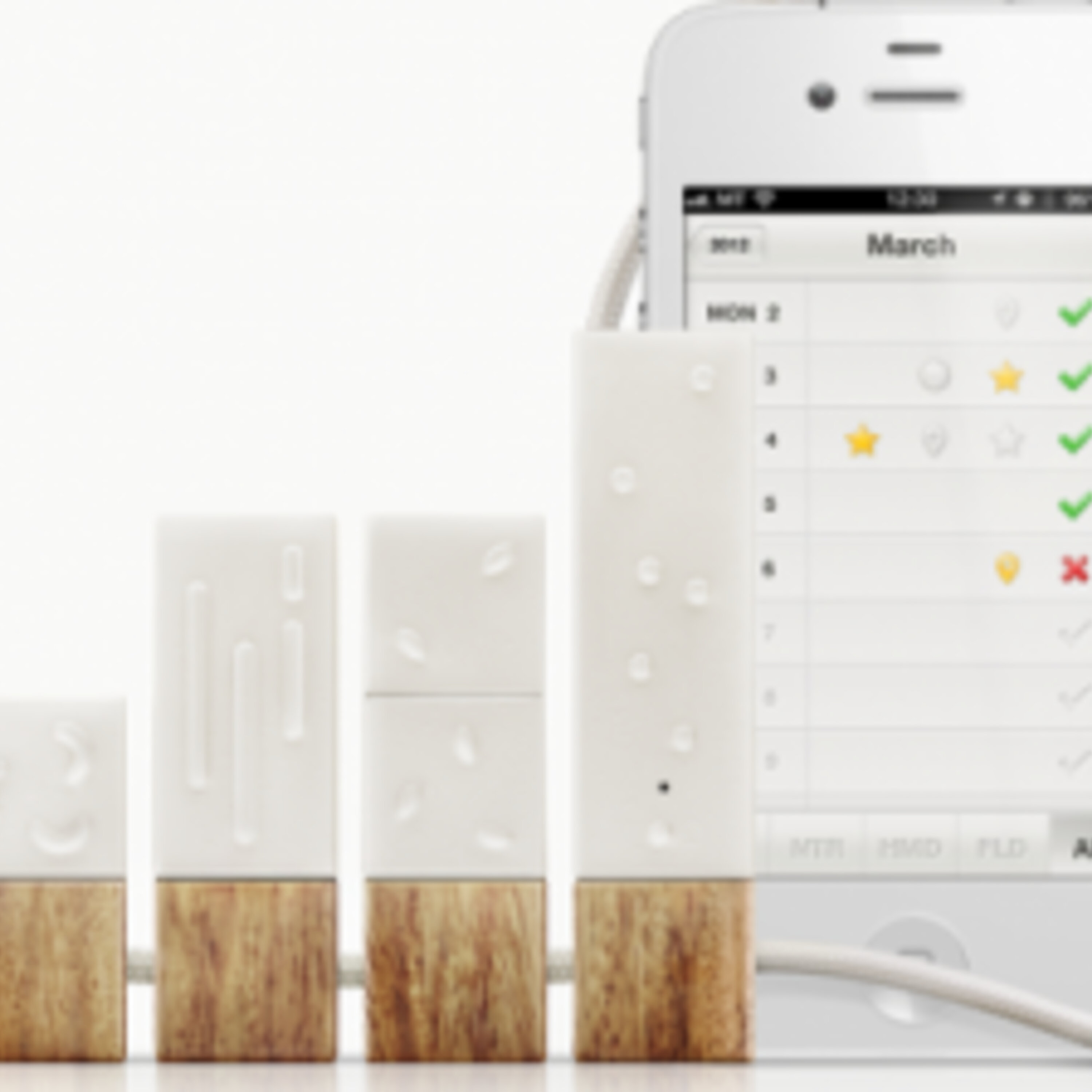
It's this set of tiny little blocks that are barely larger than Lego pieces (pictured above), and each little block can be connected to your phone to measure, collect and analyze the hidden qualities of your surroundings.
It's called a "MyLapka Personal Environment Monitor". The Lapka is a tiny, beautifully designed personal environment monitor, and in today's podcast, I interview the designer, Vadik Marmeladov.
In the interview, we talk about how the Lapka works, what it measures, how you can use it to quantify your environment to get healthier, and much more. Each little block is equipped with a set of precise sensors which respond to the invisible world of particles, ions, molecules and waves.
But Lapka doesn’t just quantify what it measures. You get results that are specific to where you happen to be at the moment. On the street, at the office, inside your baby's bedroom, or on an airplane - it actually compares readings to average guidelines for each individual environment.
The Lapka is actually comprised of four different devices that measure radiation, electromagnetic fields, humidity and how organic your produce is.
The first is Lapka Radiation, which measures all of the radioactive particles around you and is sensitive to levels of beta and gamma particles. Legal limits for radiation vary, and Lapka provides health guidelines for each. For example, a baby’s bedroom's legal limit is much lower than that of an airplane at 10,000 feet. Lapka knows to analyze in relation to this when you choose either the Airplane or Baby preset in the app.
The second is the Lapka Electromagnetic Field, which measures EMF’s caused by electronic devices, wireless transmitters, nearby power lines, etc. Lapka EMF takes measurements of both High Frequency and Low Frequency fields and can detect cell phone antenna activity, microwaves or exposed wires to reveal the spots with the least electromagnetic pollution. That’s where you might want to put your yoga mat.
Next is Lapka Humidity, which measures both the temperature and humidity of your environment. It combines and compares the results with a knowledge base of comfort standards to help you better understand your personal climate at any moment and ways that you could sleep better or think better based on temperature and humidity. Different scenarios - for example, wine storage and sleep comfort — call for different temperatures and levels of moisture (don’t sleep in your wine cellar, by the way).
Finally, Lapka Organic detects whether or not your fruits and vegetables were really grown organically. The little probe simply measures ionic conductivity, which correlates to the quantity of nitrates left behind from nitrogen-based fertilizers. Each fruit and vegetable has a defined limit for nitrate concentration, and conductivity that significantly exceeds these limits suggests the use of non-organic farming practices. So you can find out whether that organic carrot is really organic.
Do you have questions, comments or feedback about the Lapka? Do you have one and if so, how are you using it? Leave your thoughts at BenGreenfieldFitness.com!
See omnystudio.com/listener for privacy information.
Available Results
Generated results are saved to your library for reuse and search.
Choose Template
Pick the result you want. You can review provider and model before generating.
A concise first-pass summary for understanding the episode quickly.
A comprehensive, source-grounded extraction of the reusable knowledge in an episode.
A comprehensive extraction focused on health practices, protocols, claims, and safety caveats.
A dedicated analysis of warnings, limitations, trade-offs, weak evidence, and uncertainty.
Repeatable methods, frameworks, mental models, processes, and systems.
Technologies, AI models, technical methods, capabilities, limitations, and adoption implications.
A concise first-pass summary for understanding the episode quickly.
A detailed readable summary organized by chapter or topic.
A navigable map of subjects, topic flow, and suggested chapters.
A comprehensive, source-grounded extraction of the reusable knowledge in an episode.
Reusable atomic knowledge units extracted from the episode.
A comprehensive extraction focused on health practices, protocols, claims, and safety caveats.
A comprehensive extraction focused on opportunities, strategy, markets, and company building.
Explicit actions, next steps, habits, recommendations, and things to avoid.
A dedicated inventory of concrete resources named in the episode.
A dedicated analysis of warnings, limitations, trade-offs, weak evidence, and uncertainty.
A concise first-pass summary for understanding the episode quickly.
A detailed readable summary organized by chapter or topic.
A navigable map of subjects, topic flow, and suggested chapters.
A comprehensive, source-grounded extraction of the reusable knowledge in an episode.
Reusable atomic knowledge units extracted from the episode.
A comprehensive extraction focused on health practices, protocols, claims, and safety caveats.
A comprehensive extraction focused on opportunities, strategy, markets, and company building.
Scientific findings, mechanisms, studies, hypotheses, and the limits of the evidence discussed.
Technologies, AI models, technical methods, capabilities, limitations, and adoption implications.
Investment theses, assets, catalysts, valuation reasoning, time horizons, and risks.
Chronologies, actors, causes, consequences, turning points, and competing historical interpretations.
Policies, proposals, stakeholders, arguments, implementation constraints, and predicted effects.
Career paths, skills, hiring signals, workplace decisions, transitions, and limitations of the advice.
Behavioral mechanisms, biases, motivation, habits, emotions, interventions, and evidence limitations.
Economic mechanisms, incentives, indicators, market structure, forecasts, and uncertainty.
Leadership principles, team systems, organizational design, culture, feedback, and failure modes.
Audience, positioning, messaging, acquisition, retention, experiments, metrics, and failed approaches.
Teaching methods, learning strategies, practice, feedback, assessment, and effectiveness evidence.
Theses, premises, arguments, objections, values, thought experiments, and unresolved questions.
Communication patterns, conflict, boundaries, expectations, repair methods, and contextual limitations.
Books, papers, authors, courses, and other learning resources mentioned in the episode.
Repeatable methods, frameworks, mental models, processes, and systems.
Explicit actions, next steps, habits, recommendations, and things to avoid.
Memorable statements and important claims with attribution and source context.
A dedicated inventory of concrete resources named in the episode.
A dedicated analysis of warnings, limitations, trade-offs, weak evidence, and uncertainty.