Search this show’s transcripts

Shirtloads of Science

en us
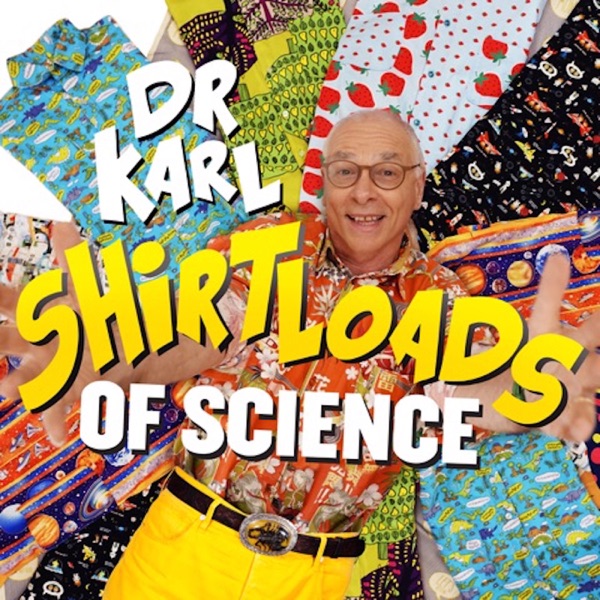
Dr Karl's a curious optimist – a great combination for a science lover. Join him and his guests for weird facts, amazing conversation and remember, it's never too late for a happy childhood. https://drkarl.com/
More details
Dr Karl's a curious optimist – a great combination for a science lover. Join him and his guests for weird facts, amazing conversation and remember, it's never too late for a happy childhood. https://drkarl.com/
Sources and links

Episodes

Page 10 · 50 per page
Published 2016-12-13

Space Historian

16 min
View

Self-described 'professional space history nerd' Amy Shira Teitel joins Dr Karl to talk about spaceflight before NASA in her book 'Breaking the Chains of Gravity'. Hear about cutting edge rocket planes like the X-15 (and its surprising link with tractor seats), the team of seamstresses behind the launch of high-altitude balloons to the edge of space, and how paper plates inspired the engineering of early spacecraft. Tune in for extraordinary, intimate stories from a time that is often forgotten in space-age literature.

More description

Self-described 'professional space history nerd' Amy Shira Teitel joins Dr Karl to talk about spaceflight before NASA in her book 'Breaking the Chains of Gravity'. Hear about cutting edge rocket planes like the X-15 (and its surprising link with tractor seats), the team of seamstresses behind the launch of high-altitude balloons to the edge of space, and how paper plates inspired the engineering of early spacecraft. Tune in for extraordinary, intimate stories from a time that is often forgotten in space-age literature.

Extract Knowledge
Listen elsewhere
Published 2016-12-12

Science Talk

14 min
View

Dr Alice has been shark hunting in the Arctic waters (i.e. through scientific papers) and discovered the oldest vertebrate in the world is at least 272 years old. Meanwhile, back on the land, why are two scientists riding a roller coaster holding a bag with an artificial kidney and stones? Dr Karl is considering a 'fusion' breakfast after hearing that spicy food may be good for your health. Fruit salad with chilli anyone? And why does the Zebra finch sing a different song to its eggs just before they hatch?

More description

Dr Alice has been shark hunting in the Arctic waters (i.e. through scientific papers) and discovered the oldest vertebrate in the world is at least 272 years old. Meanwhile, back on the land, why are two scientists riding a roller coaster holding a bag with an artificial kidney and stones? Dr Karl is considering a 'fusion' breakfast after hearing that spicy food may be good for your health. Fruit salad with chilli anyone? And why does the Zebra finch sing a different song to its eggs just before they hatch?

Extract Knowledge
Listen elsewhere
Published 2016-12-11

Marine Biology Adventures

20 min
View

Marine biologist, diver and author Dr Helen Scales takes Dr Karl deep beneath the waves to share her passion for life in the ocean. Helen talks about her new book 'Spirals in Time' on the secret life of shells. Hear about 'clacking' oysters, the legend of the Golden Fleece (sea silk) and a creature resembling a pinecone crossbred with a slug. There's mathematics in the spirals of shells, slave trading in the history of the cowrie shell and just imagine a Harry Potter golden snitch of the sea… it's real and has an incredibly important role to play in ocean life.

More description

Marine biologist, diver and author Dr Helen Scales takes Dr Karl deep beneath the waves to share her passion for life in the ocean. Helen talks about her new book 'Spirals in Time' on the secret life of shells. Hear about 'clacking' oysters, the legend of the Golden Fleece (sea silk) and a creature resembling a pinecone crossbred with a slug. There's mathematics in the spirals of shells, slave trading in the history of the cowrie shell and just imagine a Harry Potter golden snitch of the sea… it's real and has an incredibly important role to play in ocean life.

Extract Knowledge
Listen elsewhere

Dr Alice is back in the house for science chat and she's got popcorn for Dr Karl! But wait, why? They are talking movies and the science behind knowing what's going on in a film by measuring the chemicals released by the audience. Who knew there could be a link between 'The Hunger Games', the Amazon rainforest and being able to diagnose medical conditions? Find out what happened in the case of the 'poisoned pants' and what's the best time to exercise to lose weight? They ask the big questions about coffee – good or bad – and, should you really have a hot cup of tea to cool you down?

More description

Dr Alice is back in the house for science chat and she's got popcorn for Dr Karl! But wait, why? They are talking movies and the science behind knowing what's going on in a film by measuring the chemicals released by the audience. Who knew there could be a link between 'The Hunger Games', the Amazon rainforest and being able to diagnose medical conditions? Find out what happened in the case of the 'poisoned pants' and what's the best time to exercise to lose weight? They ask the big questions about coffee – good or bad – and, should you really have a hot cup of tea to cool you down?

Extract Knowledge
Listen elsewhere
Published 2016-11-27

Nutrition, Dietetics and Your Toilet Bowl

13 min
View

Clare Collins is a Professor in Nutrition and Dietetics at the University of Newcastle. She joins Dr Karl for a colourful conversation about your toilet bowl and what it can tell you about your health. Don't be shy, listen up and discover what weird colours you should not see, and what they could mean. Got green poo? There's an explanation. How about 'cappuccino' wee or purple pee? You'll be surprised. Find out when to see your GP and what to show and tell. Perhaps you'll take away Dr Karl's new mantra: 'while the eyes are the window to your soul, the toilet bowl is a window to your health.

More description

Clare Collins is a Professor in Nutrition and Dietetics at the University of Newcastle. She joins Dr Karl for a colourful conversation about your toilet bowl and what it can tell you about your health. Don't be shy, listen up and discover what weird colours you should not see, and what they could mean. Got green poo? There's an explanation. How about 'cappuccino' wee or purple pee? You'll be surprised. Find out when to see your GP and what to show and tell. Perhaps you'll take away Dr Karl's new mantra: 'while the eyes are the window to your soul, the toilet bowl is a window to your health.

Extract Knowledge
Listen elsewhere

Dr Karl and Dr Alice put their heads together to discuss the latest research into well… all sorts of stuff! What do hairy leaves have to do with burning plants? Is Dr Karl's fruit and veggie classification (serve it with ice-cream it's a fruit, with gravy it's a vegetable) scientifically accurate? And what exactly do killer kangaroos have to do with being unable to sleep in an unfamiliar bed? Listen up as the Doctors tackle these questions and more. And, if you talk to dogs (like Dr Alice does) there's an experiment you might just want to try.

More description

Dr Karl and Dr Alice put their heads together to discuss the latest research into well… all sorts of stuff! What do hairy leaves have to do with burning plants? Is Dr Karl's fruit and veggie classification (serve it with ice-cream it's a fruit, with gravy it's a vegetable) scientifically accurate? And what exactly do killer kangaroos have to do with being unable to sleep in an unfamiliar bed? Listen up as the Doctors tackle these questions and more. And, if you talk to dogs (like Dr Alice does) there's an experiment you might just want to try.

Extract Knowledge
Listen elsewhere
Published 2016-11-13

The Quest for Longitude

27 min
View

Maritime history's greatest scientific breakthrough was working out longitude, the distance (measured in degrees, minutes, and seconds) of how far a point is, either East or West, of the Prime (Greenwich) Meridian. Dr Karl unravels this discovery with Kevin Sumption and James Hunter from the Australian National Maritime Museum in Sydney, as they talk about the history of navigation and their 2016 exhibition, Ships, Clocks and Stars: The Quest for Longitude. Hear about extraordinary nautical instruments, different methodologies for calculating longitude, and the impact of these inventions and explorations on the world today.

More description

Maritime history's greatest scientific breakthrough was working out longitude, the distance (measured in degrees, minutes, and seconds) of how far a point is, either East or West, of the Prime (Greenwich) Meridian. Dr Karl unravels this discovery with Kevin Sumption and James Hunter from the Australian National Maritime Museum in Sydney, as they talk about the history of navigation and their 2016 exhibition, Ships, Clocks and Stars: The Quest for Longitude. Hear about extraordinary nautical instruments, different methodologies for calculating longitude, and the impact of these inventions and explorations on the world today.

Extract Knowledge
Listen elsewhere
Published 2016-11-06

The Open Source Malaria Project

21 min
View

Over 200 million people are infected with malaria every year. Dr Alice Williamson, research chemist, lecturer and science communicator at the University of Sydney talks to Dr Karl about her work with Open Source Malaria. This is a worldwide drug discovery project that shares all data and results (no patents please!) in an incredible collaborative effort to tackle the disease. Hear about the problems encountered, Alice's work in the lab, the thrill of working together with high school and undergraduate students, and the problem researchers are hoping to have that will point towards a possible cure.

More description

Over 200 million people are infected with malaria every year. Dr Alice Williamson, research chemist, lecturer and science communicator at the University of Sydney talks to Dr Karl about her work with Open Source Malaria. This is a worldwide drug discovery project that shares all data and results (no patents please!) in an incredible collaborative effort to tackle the disease. Hear about the problems encountered, Alice's work in the lab, the thrill of working together with high school and undergraduate students, and the problem researchers are hoping to have that will point towards a possible cure.

Extract Knowledge
Listen elsewhere
Published 2016-10-30

The Kepler Mission Scientist: Part 2

20 min
View

Part Two reveals what happened when one, and then two (!!) of the Kepler Spacecraft reaction wheels went to lunch, how the news almost drove Dr Karl to whiskey, and how the engineers found a brilliant solution and continued on with Kepler Mission 2. A jaw-dropping discussion about the discoveries made, including potentially habitable earth-sized planets, the inconstancy of stars, and the probability of finding evidence of life beyond planet Earth.

More description

Part Two reveals what happened when one, and then two (!!) of the Kepler Spacecraft reaction wheels went to lunch, how the news almost drove Dr Karl to whiskey, and how the engineers found a brilliant solution and continued on with Kepler Mission 2. A jaw-dropping discussion about the discoveries made, including potentially habitable earth-sized planets, the inconstancy of stars, and the probability of finding evidence of life beyond planet Earth.

Extract Knowledge
Listen elsewhere
Published 2016-10-20

The Kepler Mission Scientist

17 min
View

Dr Karl looks to the stars to kick off his new podcast with NASA Ames research astrophysicist Dr Natalie Batalha, the Kepler Mission Scientist. From 2009 to 2013, the Kepler Space telescope looked for exoplanets – planets outside our solar system. It stared unblinkingly at a patch of sky which Dr Batalha had selected hoping to find not just exoplanets, but exoplanets in the Goldilocks zone. Find out what happened, what can go wrong and how Dr Karl's mind was blown to astronomical proportions.

More description

Dr Karl looks to the stars to kick off his new podcast with NASA Ames research astrophysicist Dr Natalie Batalha, the Kepler Mission Scientist. From 2009 to 2013, the Kepler Space telescope looked for exoplanets – planets outside our solar system. It stared unblinkingly at a patch of sky which Dr Batalha had selected hoping to find not just exoplanets, but exoplanets in the Goldilocks zone. Find out what happened, what can go wrong and how Dr Karl's mind was blown to astronomical proportions.

Extract Knowledge
Listen elsewhere
Show details
Episodes
460
Transcripts
0
0% coverage
Missing transcripts
460
With chapters
0